Saturday, April 27, 2019

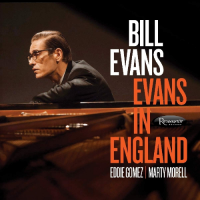
Bill Evans - Evans In England

Bill Evans

By Marc Myers at JazzWax
The year 1969 was a busy one for pianist Bill Evans. In January and March, Evans with bassist Eddie Gomez and drummer Marty Morell recorded What's New with flutist Jeremy Steig. In February, the trio was recorded furtively at New York's Village Vanguard (The Secret Sessions). Then they moved on to Holland in March (Live In Hilversum 1969) and Italy in July (Autumn Leaves). Back in New York in early November, Evans began recording From Left to Right, his moody Fender Rhodes-acoustic piano album backed by an orchestra. Later that month, the trio recorded live in Copenhagen (Jazzhouse) and Amsterdam (Quiet Now).
Finally, on December 1, the Bill Evans Trio opened at Ronnie Scott's Jazz Club in London, a run that would last until December 27. At various points during the month, the gig was beautifully recorded. The music captured Bill at his gentle and poetic best, a throwback to his playing of several years earlier. The recording has just been released on Evans in England (Resonance). Like the Wes Montgomery set that I reviewed yesterday, this two-CD set with a 36- page booklet of liner notes and interviews was produced by Zev Feldman.
According to Zev's introductory essay, the tapes were in the possession of a friend of Leon Terjanian, a resident of Strasbourg, France, who is among the world's many “trench coat" tape collectors. These fans own rare and previously unreleased recordings of major artists and trade them among each other. Zev traveled to Strasbourg twice to meet with Terjanian and to hear the tapes, research them and negotiate for their release. Terjanian would befriend Evans and film him in Lyon in 1978, using footage in his film, Turn Out the Stars, which was screened just once at the Montreal Jazz Festival in 1981.
As Zev was preparing Evans in England, he reached out to me for the album's main liner notes. To ensure that Evans was actually at Ronnie Scott's in December 1969, I called the club in London to verify the dates. They weren't sure, since their records were incomplete. So I went off to the New York Public Library for the Performing Arts, Dorothy and Lewis B. Cullman Center at Lincoln Center, one of the finest arts research facilities in the city.
After an hour on the microfilm projector scrolling through the 1969 Melody Maker, the British music tabloid that published from 1926 to 2000, I found ads for the Bill Evans Trio at Ronnie Scott's throughout December.
For the notes, I also interviewed Marty Morell, my favorite Bill Evans drummer. I love Marty's delicate but determined touch and how he plays in and around Evans. After listening to the tapes, Marty said, he was certain the music was recorded in December 1969. During that visit to London, Marty recalled, he agreed to endorse Paiste cymbals, a Swiss company. Midway through the Ronnie Scott's run, he said, he switched out his Zildjian cymbal for a Paiste “Free Ride"—a cymbal without a bell.The model let him ride the cymbal without overshadowing Evans's playing, something that Evans's mother had groused about months earlier in Washington, D.C.
The final mind-blower that emerged from my research for these notes was the origin of Elsa. Composed by Earl Zindars, the song was an Evans favorite and appears on numerous Evans albums over the years. The list includes Explorations, Trio '65, Paris 1965, Momentum, Live in Paris 1972, Re: Person I Knew, among others.
Despite going through the liner notes of these albums and thumbing through books, no one ever bothered to look into why Earl Zindars named the song Elsa. Who was this woman? I called Anne Zindars, the late composer's wife. Here's what she told me: “After Earl wrote the song, I asked him, 'So, who's Elsa?' Turns out the song was named for the lioness, Elsa, in the 1960 book, Born Free, which became a movie in '66. Earl loved the book when it came out."
I think you'll find that Evans in England is the finest live recording by this trio and easily in the top five by Evans in general. For me, it's bested only by Sunday at the Vangaurd/Waltz for Debbie recorded in 1961 and Bill Evans at Town Hall in 1966. As you'll hear, the music in London is alive and spry without Evans's keyboard agitation or complaint. All 18 tracks feature Evans at ease; Gomez conversational, not nagging; and Morell on sticks and brushes egging Evans along. We're lucky that such artistic grace surfaced and that Resonance producers Zev Feldman and George Klabin had the wisdom and determination to put the music out.
Bill Evans died in September 1980.

Sunday, November 12, 2017

Another Time - The Hilversum Concert

Bill Evans - Another Time: The Hilversum Concert


By Fred Kaplan
Resonance Records is emerging as the most vital jazz reissue house around—or, rather, not "reissue," for the music they put out has never been issued before: the producer Zev Feldman (or someone who contacts him) has found it in an unexamined vault, back room, or collectors' cove. The material is top-flight, the sound very good to excellent, and he often releases the albums on CD and LP. So far he has delivered some of the best albums ever by Larry Young, Sarah Vaughan, Shirley Horn, and the Thad Jones/Mel Lewis Orchestra, but Feldman holds a special regard for Bill Evans.
The final few years of Evans, who died in 1980 at age 51 of complications from drug addiction and other ailments, have been preserved entirely by posthumous discoveries: The Paris Concert (Elektra Musician), The Last Waltz and (Milestone), Turn Out the Stars (Nonesuch)—without these sunset gems, all live sessions, we'd think that Evans faded out with a string of dreary studio albums, some of them with electric piano. (For a sad but fascinating documentary of Evans' life and music, including many rare films clips, see Bruce Siegel's Time Remembered.)
Resonance is now filling in some blanks from Evans' middle years, the late 1960s, for which there's also a paucity of albums, or at least of very good ones. The best of the new stack is the latest, Another Time, recorded before a live audience in the studio of Netherlands Radio Union in Hilversum, outside Amsterdam, on June 22, 1968. Until this release, no one ever knew the tapes of this performance existed.
It is also one of just three albums featuring his trio with Eddie Gomez on bass and Jack DeJohnette on drums—the others being The Montreux Concert (which was released by Verve at the time) and another Resonance discovery, put out two years ago, Some Other Time: The Lost Session in the Black Forest. The Hiversum set was the climax of the trio's three sessions we now know of—recorded two days after Some Other Time, five days after Montreux.
The Montreux Concert is widely considered one of Evans' best albums; some place it just behind his wondrous back-to-back 1961 sessions, Waltz for Debby and Sunday Afternoon at the Village Vanguard. I would put Another Time on the same level as Montreux, and the sound quality is nearly as good.
The Gomez-DeJohnette trio was by far his best since the '61 band with bassist Scott LaFaro and drummer Paul Motian, which was disrupted when LaFaro, 10 days after the Vanguard sets, died in a car accident, a tragedy from which Evans never quite recovered. (The '68 trio didn't last long either: soon after these sets, DeJohnette was recruited by Miles Davis; Gomez stayed on, but the subsequent drummers weren't quite as polyrhythmically sublime.) Evans himself, who'd dipped deeper into addiction after that event, is in fine form: elegiac, romantic, lyrical—all the adjectives usually attached to his pianism, but there's also a buoyancy and sometimes a fervent swing that his name doesn't so commonly evoke. And it's a joyous fervency, not the cocaine-fueled frenzy one hears on some of his last albums (eg, his 1980 Vanguard set, Turn Out the Stars).
Evans' most energetic albums seem to be the live ones. Some Other Time, the Resonance album recorded in a Black Forest studio, though mainly quite good, has passages of rote playing.
The sound quality on Another Time, the Hilversum concert (the similarity in titles is unfortunate), is superb on CD and better still on LP, unmatched by any other Evans albums except for Montreux and the better Riversides. Many years ago, the long-lamented Classic Records released an excellent limited-edition 45rpm remastering of Montreux, which sounded better than the original pressing; someone should think about a re-release.
Meanwhile, there's this, and Feldman tells me there are more excavated treasures to come.

Read more at:
https://www.stereophile.com/content/bill-evans-another-time-hilversum-concert#tQ5PCyzTSwo70cxI.99

Track Listing:
You're Gonna Hear from Me; Very Early; Who Can I Turn To?; Alfie; Embraceable You; Emily; Nardis; Turn Out the Stars; Five.
Personnel:
Bill Evans: piano; Eddie Gomez: bass; Jack DeJohnette: drums.

Tuesday, January 3, 2017

Bill Evans - Some Other Time: The Lost Sessions From The Black Forest

Some Other Time: The Lost Sessions From The Black Forest


By Mark Richardson Executive Editor
Some Other Time is a newly unearthed Bill Evans studio album, initially recorded in 1968 in Germany but not released until this month. It still sounds fresh and alive almost 50 years later.
Casual jazz fans know Bill Evans through his association with Miles Davis. Kind of Blue, the one jazz album you own if you only own one, features Evans on piano on four of the five tracks, and his brief liner notes sketch out the group's approach to improvisation in poetic and accessible terms. When you learn a bit more about Kind of Blue, you learn that Davis actually envisioned the record with Evans in mind. And though for years Davis was listed as the album's sole composer, Evans wrote "Blue in Green" (he eventually received credit.)
Another Kind of Blue piece, "Flamenco Sketches," was partly based on Evans' arrangement of "Some Other Time," the Leonard Bernstein standard. (Evans had earlier used the slow opening vamp as a building block to his breathtaking solo piano composition "Peace Piece"). So though he may not be an especially famous jazz musician, Bill Evans played an integral role in shaping the most famous jazz recording of all time, and the arc of his discography is a rewarding one for those branching off from classic Miles. "Some Other Time" continued to be a touchstone piece for Evans for the rest of his life, appearing regularly on his albums (notably on his duet record with Tony Bennett). And now it's become the title track to a newly unearthed studio album, one recorded in 1968 in Germany but not released until this month.
Jazz in general overflows with archival material. It's a live medium, and recordings of shows have been common since the early part of the last century. Studio LPs could typically be cut in a couple of days, which generally meant a wealth of unused songs and outtakes. But it's somewhat rare to have a true unreleased album—a collection of songs recorded together at a session with the thought of a specific release that never saw the light of day.
Some Other Time: The Lost Session From the Black Forest is one of these. It was recorded when Evans was on tour in Europe with a trio that included Eddie Gomez on bass and, on drums, a young Jack DeJohnette, who would go on to much greater fame with Miles Davis, Keith Jarrett, and as a leader himself. It was cut between stops on a European tour by German producer Joachim-Ernst Berendt, with the idea that the rights and a release plan would be figured out later. This particular group had only been documented on record just once, on At the Montreux Jazz Festival, recorded five days prior to this date. So the existence of an unheard studio album by the trio is a significant addition to the Evans story.
The piano/bass/drums trio setting is where Evans did his most important and lasting work. He thrived on both the limitations and the possibilities of the set-up, and returned to it constantly over the course of his quarter-century recording career. He generally favored truly collaborative improvising in the setup; the bassist in his trio was expected to contribute melodically and harmonically, in addition to rhythmically, and he could often be heard soloing alongside the pianist. Eddie Gomez, heard on this album, was a steady partner of Evans' for a decade, and the level of empathy between the two players is something to behold. On "What Kind of Fool Am I?," Gomez's dancing lines darts between Evans' bass notes, almost serving as a third hand on the piano. On the immortal title track, Gomez seems like half a conversation, accenting and commenting on Evans' melodic flourishes. For his part, DeJohnette offers tasteful and low-key accompaniment, heavy on the brushwork and soft textures on cymbals—he was more of a role-player at this point in his career. But the three together feel like a true unit.
The tracklist on Some Other Time is heavy on standards, with a few Evans original sprinkled in. To love the American songbook is to be in love with harmony, and Evans never stopped discovering new possibilities in old and frequently played songs. He had a way of phrasing chord progressions for maximum impact, and he used space as virtually another instrument. Evans recorded "My Funny Valentine" many times in a number of different arrangements, often uptempo, but here he drags it out into an achingly poignant ballad that picks up speed as it goes. In his autobiography, Miles Davis famously described Evans' tone as sounding like "like crystal notes or sparkling water cascading down from some clear waterfall," and the tumble of notes on the faster sections of "My Funny Valentine" evince that crystalline loveliness. In addition to the material planned for the original LP, there's a second LP of outtakes and alternate versions that feels very much on par with the first disc.
Evans' art has endured in part because he has a brilliant combination of formal sophistication and accessibility; critics and his fellow musicians heard the genius in his approach to chords, his lightness of touch, and his open-eared support of others in his band, while listeners could put on his records and simply bask in their beauty, how Evans' continual foregrounding of emotion made the sad songs extra wrenching and the happy ones extra buoyant. He was sometimes criticized for an approach that could sound like "cocktail piano," meaning that it wasn't terribly heavy on dynamics and tended to be lower key and generally pretty, but this turned out to be another strength. If you wanted jazz in the background while engaging in another activity, Evans was your man, and if you wanted to listen closely and hear a standard like "Some Other Time" pushed to the limits of expression by his ear for space, he was there for that too.
Evans was one of those jazz artists who changed relatively little over the course of their career. His style developed and his sound had subtle shifts in emphasis over time, but his general approach to music was remarkably consistent, and he remained apart from most of the fashionable trends that wound through the jazz of his era. His first studio date as a leader, in 1956, was just a year after Charlie Parker's death, with bebop very much still au courant; his last, in 1979, the year before his death, was the year Chuck Mangione was nominated for a Grammy for the discofied light jazz funk of "Feels So Good." In both of those years, Evans recorded small-group acoustic jazz albums featuring his standard trio, playing a mix of standards and a few originals. About midway between those two bookends came this set, recorded in a small studio in Germany and left on the shelf, and it still sounds fresh and alive almost 50 years later.

Saturday, December 13, 2014

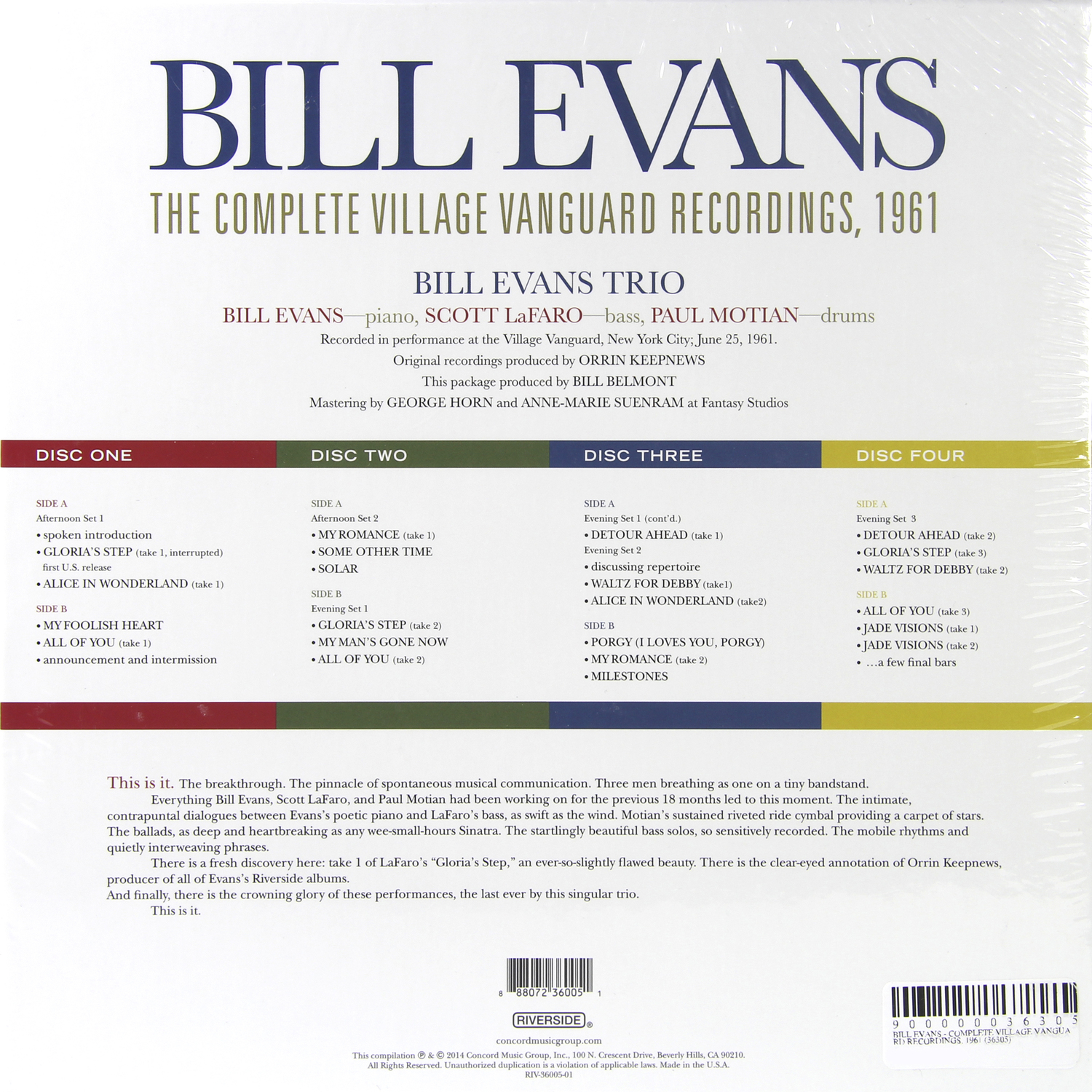
Bill Evans - The Complete Village Vanguard Recordings, 1961 (The Vinyl Box Set)


By Concord Music Group 

Concord Music Group is proud to announce the forthcoming vinyl reissue of Bill Evans’ The Complete Village Vanguard Recordings, 1961, one of the greatest live jazz recording sessions of all time. Pressed on 180-gram vinyl, the four-LPs box set is packaged with a 12-page booklet, complete with new liner notes by reissue producer Bill Belmont, as well as the original liner notes by the producer of the initial recordings, Orrin Keepnews. Reproductions of Keepnews’ session annotations and photographer Steve Schapiro’s proof sheets from the performances add vintage context to the packaging. As a bonus, a stunning metallic and black poster of the famous cover—Evans, in profile, deep in concentration at his piano—completes the box set.
Ranked time after time as one of the best live jazz recording sessions in history, and yielding two of Evans’ most classic albums (Waltz for Debby, Sunday at the Village Vanguard),The Complete Village Vanguard Recordings, 1961 represents the pinnacle of spontaneous musical communication: three men breathing as one on a tiny bandstand. The performances on these LPs demonstrate a new and more interactive approach to playing as a trio, one in which all instruments carry melodic responsibilities and function as equal voices. Keepnews recalls in his liner notes that “from the very first moments of the recording, it was impossible to ignore the importance of these performances.”
Everything Bill Evans, Scott LaFaro, and Paul Motian had been working on for the previous 18 months led to this moment on June 25, 1961. The little-known pianist and his trio performed afternoon and evening sets that Sunday to a small audience that unknowingly sat through what would become a very famous—and final—set by the trio (the 25-year old LeFaro died tragically in a car accident just days later). These recordings provide something of a sonic time capsule: sequenced in the original order of the five sets, the audience’s murmurings and applause are peppered throughout; even an interrupted take is left intact. Belmont recalls the process of piecing the performance back together during the remastering process: “As was the practice with early live recording, the songs [on the original album] were faded just after the last note, and much, if not all, of the audience and banter from the stage was removed. So the first stage of the process was to find the reels—if they existed—and try and make a reconstruction of everything that was recorded…The task was to try to make the show flow as closely as possible to what had been recorded.”


By Jeff Tamarkin at JazzTimes 

Concord Music Group is reissuing Bill Evans’ The Complete Village Vanguard Recordings, 1961, as a vinyl box set. Pressed on 180-gram vinyl, the four LPs are packaged with a 12-page booklet, complete with new liner notes by reissue producer Bill Belmont, as well as the original liner notes by the producer of the initial recordings, Orrin Keepnews. The set also includes reproductions of Keepnews’ session annotations and photographer Steve Schapiro’s proof sheets from the performances. As a bonus, according to a press release, a metallic and black poster of the album cover—Evans, in profile, deep in concentration at his piano—completes the box set.
The original recording was made June 25, 1961, at the New York venue and features pianist Evans with bassist Scott LaFaro and drummer Paul Motian.
Concord also plans a 12-disc reissue of The Complete Riverside Recordings for early 2015. That set presents all 20 recording sessions from the eight-year period (1956-63) that launched Evans’ career. These 151 performances are presented in what’s described as “a sleek brick box,” along with a 32-page illustrated booklet. Due in January is the four-LP set The Complete Tony Bennett/Bill Evans Recordings, which encompasses the duets Bennett and Evans recorded in 1975 and 1976. New liner notes by music critic and co-author of Bennett’s autobiography, Will Friedwald, complete the package.

Track Listing for The Complete Village Vanguard Recordings, 1961:
Disc 1
Side A: 
1. Spoken Introduction 00:43 
2. Gloria's Step (Take 1, Interrupted) 5:41 
3. Alice In Wonderland (Take 1) 6:57
Side B: 
1. My Foolish Heart 4:55 
2. All Of You (Take 1) 8:14 
3. Announcement And Intermission 1:44
Disc 2
Side A: 
1. My Romance (Take 1) 7:11 
2. Some Other Time 5:02 
3. Solar 8:57
Side B: 
1. Gloria's Step (Take 2) 6:10 
2. My Man's Gone Now 6:21 
3. All Of You (Take 2) 8:29 
Disc 3
Side A: 
1. Detour Ahead (Take 1) 7:17 
2. Discussing Repertoire 00:31 
3. Waltz For Debby (Take 1) 6:46 
4. Alice In Wonderland (Take 2) 8:31
Side B: 
1. Porgy (I Loves You, Porgy) 6:09 
2. My Romance (Take 2) 7:26 
3. Milestones 6:31 
Disc 4
Side A: 
1. Detour Ahead (Take 2) 7:41
2. Gloria's Step (Take 3) 6:48 
3. Waltz For Debby (Take 2) 7:00 
Side B: 
1 All Of You (Take 3) 8:18 
2. Jade Visions (Take 1) 4:12 
3. Jade Visions (Take 2) 3:57 
4. ...A Few Final Bars 1:15

Sunday, September 21, 2014

Martin Wind's Homage to Bill Evans

Martin Wind Quartet & Orchestra Filarmonica Marchigiana
Turn Out The Stars: Music Written or Inspired by Bill Evans


By Mark Corroto
Has an artist ever been characterized as a hopeful romantic? If not, then let us nominate Martin Wind, not as hopeless, but a bullish and inspiring romantic. His quartet and the 36- piece Orchestra Filarmonica Marchigiana tribute to pianist Bill Evans Turn Out The Stars marries his talents, both as a jazz bassist/bandleader and orchestral arranger.
Besides leading his own quartet, and working in trio with Bill Mays and Matt Wilson, and in the guitar/bass duos with Philip Catherine or Ulf Meyer, Wind is an in-demand sideman featured in multiple projects, including Matt Wilson's Arts & Crafts and bands led by, Ted Nash, Gary Smulyan, and Pete Mills, to name just a few. He released two stellar recordings in 2013, the CD Ulf Meyer and Martin Wind At Orpheus Theater (Laika) and an audiophile LP Remember October 13th (Edition Longplay).
Recorded live at the Theatro Rossini in Pesaro, Italy, Wind's quartet includes his regular partners, saxophonist Scott Robinson and pianist Bill Cunliffe, plus drummer Joe LaBarbera, who was Bill Evans' drummer in the pianist's final trio (1978-1980). This homage to Evans is enhanced by the gorgeous and passionate arrangements Wind wrote for conductor Massimo Morganti's orchestra. The disc opens with the title track, an overture in full bloom that gives way to the quartet's recitation of melody with Robinson's saxophone laying down velvety notes. Each piece— such as the spry rendition of "The Days Of Wine And Roses," performed by the quartet or full orchestra—is dexterously accomplished. Wind has the knack for extracting the sweetest juice for each piece written by Evans or written in tribute to the great one. La Barbera's composition "Kind Of Bill" opens with a piano and bowed bass duo, then lingers in that romantic atmosphere Evans loved to reach for.
Even in full orchestra, the quartet is never overwhelmed. The luscious arrangement of "Blue In Green" plays off of the contrasts of lightness and dark, the orchestra a pastoral landscape for the quartet to rollick. The tricky "Twelve Tone Tune Two" pushes the orchestra into a challenging interchange with La Barbera's drums and the coughing horn of Robinson. At the center of this gorgeous evening is the stalwart bass of Wind, the infrastructure upon which both a quartet and a very large orchestra is held by his passionate zeal.
Track Listing:
Turn Out The Stars; My Foolish Heart; The Days Of Wine And Roses; Jeremy; Memory Of Scotty; Kind Of Bill; Blue In Green; Twelve Tone Tune Two; Goodbye Mr. Evans.
Personnel:
Martin Wind: bass; Scott Robinson: tenor saxophone, C melody saxophone; Bill Cunliffe: piano; Joe La Barbera: drums; Orchestra Filarmonica Marchigiana - Massimo Morganti: conductor.

Saturday, June 14, 2014

Bill Evans Trio - LeJazz/Charly From the 90's

Bill Evans
Serenity


Bill Evans envisioned a piano trio in which the bassist and drummer wouldn’t be accompanists but equal participants. Further, without any attempts at obvious fusion, he melded elements of late 19th- and early 20th-century classical music into his approach, along with a quiet but powerful lyrical quality still based in jazz. SERENITY captures a live Evans radio broadcast with his regular bandmates from the early and mid-‘70s--Eddie Gomez (bass) and Marty Morell (drums)--performing Evans's best-loved favorites such as "Re: Person I Knew" and "Waltz For Debby."


The Bill Evans Trio
Quiet Now


By Stewart Mason
An aptly titled album from the Bill Evans Trio, Quiet Now is the jazz pianist at his most ambient and cerebral. Accompanied only by the minimalist rhythm section of bassist Eddie Gomez and drummer Marty Morell, Evans effortlessly deconstructs two pop standards, Harold Arlen's "Sleeping Bee" and his beloved "Autumn Leaves," a Johnny Mercer tune that he played seemingly hundreds of times, along with three of his own compositions and Miles Davis' "Nardis," a song Evans made his own through endless reintepretation over the course of many years. Morrel is a steady, unobtrusive drummer with a light touch and, happily, not much of a tendency to show off and even less to solo. Gomez, the bassist Evans worked with the longest in his career, knows how to anticipate his boss' every move, no matter how seemingly random, and his solo spots are those rarities, economical and well-constructed bass solos that are actually fun to listen to. Quiet Now is a bit too workmanlike to be one of the greatest Bill Evans Trio releases -- it's more solidly competent than divinely inspired, but Evans' playing, as always, is marvelous.

Saturday, June 8, 2013

BILLBEATLES


By Claudio Botelho
They’re two different entities, but equally enticing in remaining far and above their peers. They’ve transcended their gender for long and seriously stretched their proposed boundaries into other realms, and the passing of time has only made they garner more recognition.
Bill Evans was more erudite, at least at the delivery for consumption. The Beatles’ music was purposely done to younger and wider audiences, and both musical legacies have acquired an uncanny transcendence by achieving a timeless reputation of unsurpassed quality.
These two phenomena of our time are unique. No rock band (was the Beatles a rock band?) or piano trio were ever like them, even at a glance.
When the Beatles came out, I was already irreversibly committed to jazz. I started with Dave Brubeck and Oscar Peterson, and Bill Evans wasn't yet in my foreseeable future, but this alone was all I needed to be away from that British group or any other of its kind whatsoever.
But how could I overlook their ubiquitous presence? It was an impossible mission, for the simple reason they were everywhere. As a natural consequence, they were just present in my life, but I wasn’t a repository of any of their influences, or so thought I. If their music were ever listened attentively by me, it was through the good services of jazz musicians (Ramsey Lewis comes to my mind). Otherwise, their tunes would pass me unnoticed, as much as, to be truthful, any other kind of music was it popular or classic. I was already very hooked to the jazz language.
Until the arrival of the album “Sgt. Pepper’s Lonely hearts Club Band”, The Beatles were just one more pop musical group among many others for me. But then, all of a sudden, I was embedded in songs like “With a Little Help from my Friends”, “Getting Better”, “She’s Leaving Home”, “Being for the Benefit of Mr. Kite”, “Lovely Rita”, “Good Morning, Good Morning”, “Lucy in the Sky with Diamonds”, the fantastic impressionist arranged “A Day in the Life” and five others. I was taken aback; shocked I was!... I surely didn’t know that, music wise, what inside that production was out of the reach of John, Paul, George and Ringo or even of the fifth Beatle, but I gathered I was in front of something seriously BIG!
Besides being in front of a musical presentation as dissimilar as any I had ever heard so far, I couldn't find any link between the compositions as if they were done by entirely different minds! Each one had a richness all its own and, so, seemed unique to me. By that time, I was halfway in my teens and the “needle” of my case-type monaural Philips disk player was worn out playing that masterpiece.
Keep to you this: Sgt. Pepper’s was the first and the last album of its kind I've ever brought home to listen to…
Bill Evans. To start with, he was responsible for bringing people from the kitchen to the living room. So, bassists and drummers are now on par with sax, trumpet and piano players. His 1961 trio with Scott LaFaro and Paul Motian was the starting point. I don’t know the extent of the role of Lafaro’s exquisite playing: he certainly wasn’t a common bass player and the way he treated his instrument needed more space to bloom. Was Evans’ brain the one behind this revolution or was he simply an attentive witness to a phenomenon which needed to follow its course? Did he, keenly, spot the enhancement LaFaro’s performance could bring to his group and to his music altogether and, then, just put it to work?
Certainly, a no-leader-three-leader group would become much stronger, provided it had some kind of invisible guide to put everything together. Evans leadership spoke through his enormous musical talent, no matter how well mannered he was as a human being: never authoritative, but an authority himself.
Surely, that “three-leadership-group” of his and its inherent symbiosis brought about the best of everybody. His cohorts have become much more part of the whole than ever before… (Some utilitarianism was welcome here…)
Of course, to be the first to achieve this would imply having a personal character of a certain kind; it should be honest enough to give more ground to his partners and not be afraid of losing relevance. Some humbleness was required here; a thing geniuses are commendably known to have. …
Was it the way things went by? I don’t know. Maybe, about this I’m the most ignorant man around…
What I know is that his trio was the beginning of a new trend which has reigned ever since. Wasn’t Evans such a formidable talent, this alone would have been enough to put his name in the top echelon of jazz.
About him, there’s not anything new I can address; everything has been said about this giant, so… (I’ve heard that Alain Broadbent, when listening to him for the first time, busted into tears and decided to follow his steps).
Since his early passing, we’ve been trying to find someone who could fill, at least partly, the enormous gap he left behind to fulfill our needs. From then on, we’ve examined people like Fred Hersch, Enrico Pierannunzi, Lynne Arriale, Alan Broadbent, Bill Charlap, Tord Gustavsen, Roland Hanna, Eddie Higgins, Hank jones, Andy Laverne, Bobo Stenson, Bill Mays, Walter Norris, Alan Pasqua, Gonzalo Rubalcalba…
Do you know what? Heeeeeeeeelp!... The gap remains unfulfilled, and there’s nothing on the horizon to show otherwise.
But, alas, BillBeatles? Why is this?
All this is just to say these are two musical entities which I feel will never be superseded, no matter how things evolve, no matter what progress man can bring to this divine art named music. This is the proof of the existence of something which can’t be smelled, viewed or touched; something science will never explain, which is well beyond any dissection ever to be tried…

Saturday, November 17, 2012

New CD 2012 - Part Three

Bill Evans ( with Eddie Gomez and Marty Morell )
Momentum


By Ken Dryden
During the last decade of his life, Bill Evans had developed such a devoted fan base that many of his performances were audience-recorded, particularly when he toured Europe. This previously unissued concert was recorded in Groningen, The Netherlands with the approval of the pianist's manager Helen Keane, but remained in private hands until its release four decades later. The music was well recorded and the tapes were properly stored, so there is no problem from aging. Evans' trio with bassist Eddie Gomez and drummer Marty Morell is in top form throughout this concert, while the repertoire will be familiar to the leader's fans. The pianist is in a reflective mood, especially on his introspective "Re: Person I Knew." Evans' former bassist Scott LaFaro had died tragically just days after the trio's historic Village Vanguard recordings, but LaFaro's driving "Gloria's Step" remained in Evans' repertoire for the rest of his life; Gomez's adept playing is a highlight of this hard-charging performance. Composer/pianist Denny Zeitlin believes that Evans' performance of his requiem-like ballad "Quiet Now" is among the finest interpretations of Zeitlin's well-known work.
The second set finds the trio stretching out a bit more, with a brisk take of "My Romance" and a sparkling rendition of Evans' delicate ballad "Sugar Plum." The pianist's emotional side is prominent in his ballad "The Two Lonely People" and the moving take of Michel Legrand's timeless ballad "What Are You Doing the Rest of Your Life," while he turns "Who Can I Turn To" into a playful, upbeat celebration, showcasing Gomez's brilliant solo. Sadly, the engineer ran out of tape before the trio could complete their inevitable closing number, a tense setting of Miles Davis' modal masterpiece "Nardis," which became a signature song for the pianist not long after he recorded it as a sideman with Cannonball Adderley. The detailed liner notes by several contributors provide additional historical and critical perspective.

Sunday, November 11, 2012

New CD - 2012 - Part Two

Bill Evans
The Sesjun Radio Show 


by Ken Dryden
Bill Evans was frequently recorded for radio broadcast during his various European tours, many of which ended up as bootlegs with incorrect song and personnel listings, poor audio, and incomplete tracks. Fortunately, everything is done right in this two-CD set, which is compiled from three separate performances between 1973 and 1979. The first five tracks are from a duo tour with the phenomenal bassist Eddie Gomez, who spent over 11 years with the pianist. The absence of a drummer (Marty Morell was evidently not a part of this tour, though he played with Evans into 1974) gives Evans a more intimate sound; Evans seemed to achieve an incredible E.S.P. playing with the talented Gomez. Following a buoyant opener, "Up with the Lark," the duo's moving setting of Evans' bittersweet, lyrical "Time Remembered" is a reminder of the pianist's total mastery of ballads, as is his equally touching "The Two Lonely People." There are plenty of fireworks in the pianist's "T.T.T. (Twelve Tone Tune)" as the two musicians use his dissonant theme as a jumping-off point for brilliant improvisations. The 1975 set adds drummer Eliot Zigmund, who spent four years with Evans. In these trio selections, the pianist introduces each theme alone, though it is a diverse five-song set. Evans' upbeat "Sugar Plum" showcases the leader extensively, with the rhythm section coming in several minutes later. There were several modern pop songs that drew the pianist's attention, including Bobbie Gentry's "Mornin' Glory" (which incorrectly lists Glen Campbell as co-writer), which Evans transformed into a potent jazz ballad. Evans' "T.T.T.T. (Twelve Tone Tune Two)" is even more demanding than its predecessor, with the trio navigating its pitfalls with ease in a wild, breezy performance. The 1979 tracks will be of great interest to Evans' fans. The new trio, with the brilliant young bassist Marc Johnson and superb, subtle drummer Joe LaBarbera, achieved a level of playing close to the pianist's group with Scott La Faro and Paul Motian. The trio selections cover familiar territory but find the band at its peak, highlighted by the lightly swinging take of Tadd Dameron's "If You Could See Me Now" and Evans' always introspective exploration of Miles Davis' "Nardis," the latter tune individually showcasing all three musicians. Harmonica virtuoso Toots Thielemans, who appeared on Evans' Affinity album, is a special guest on the last five songs, adding a sizzling solo to "Blue in Green" and getting to play his signature song "Bluesette" with the trio as well. The temporary quartet also nicely gels with a romp through Evans' longtime set closer "Five." The Sesjun Radio Shows is an essential collection for fans of Bill Evans.


By Dean R. Brierly (Studio City, CA)
Few jazz artists end up profoundly changing the way subsequent musicians approach their particular instrument. Bill Evans was one. Miles Davis recognized this fact when he hired Evans to play on the seminal recording "Kind of Blue." But even if that historic encounter had never occurred, Evans would still have been known as a pianist's pianist, a man whose unique phrasing, rhythmic sense and emotional color put him in an exclusive category of one. Like most great musicians, Evans was at his best in live settings, as his early 1960s and 1980 Village Vanguard recordings attest. Now, with this Sesjun Radio Shows two-disc set, fans have further opportunity to appreciate the deepened levels of his art throughout the 1970s. The pianist, who was to tragically die in 1980 at the age of 51, is featured in concerts from 1973 (a duo setting with bassist Eddie Gomez); 1975 (with Gomez and drummer Eliot Zigmund); and 1979 (with bassist Marc Johnson, drummer Joe LaBarbera and harmonica legend Toots Thielemans). Each of these concerts is distinct in character while remaining true to Evans' sound. The 1973 interplay between Evans and Gomez might be my favorite. Gomez matches Evans note for inventive note, and the minimalism of the setting really seems to inspire both men to greater heights. Evans' music has been described in lots of different ways, but I always think of him in terms of transfiguration. You can hear in his playing a continual attempt to keep setting the bar higher for himself, to say something new and profound each time his fingers touched the keyboard. And from a listener's perspective, one nearly always comes away from an Evans performance feeling a tangible sense of renewal and optimism. You can't ask more from music or a musician.

Sunday, September 16, 2012

New CD - 2012

Bill Evans
Live At Art D´Lugoff´s Top Of The Gate


By C. Michael Bailey
Why is pianist Bill Evans so important to jazz? it is simple: every pianist to hear and perform after him was influenced by him. Art Tatum and Oscar Peterson may have been technically more brilliant and extroverted, but it took first Bud Powell and then Evans to turn the creative tables toward the muted and introverted, thereby beginning a jazz piano cultural revolution that continues to this day. Evans had an almost painfully personal style that, like late-period Art Pepper, bared naked his troubled soul in exquisite detail.
This never-before-released sides from Resonance Records, Live At Art D'Lugoff's Top of The Gate, is notable for having a couple of firsts: it's the first-ever documented Evans trio recordings of "My Funny Valentine" and "Yesterdays," while "Witchcraft" is Evans' only recording of this Cy Coleman-Carolyn Leigh song, aside from the 1959 studio version appearing on Portrait in Jazz (Riverside).
It is "My Funny Valentine," however, that shines most brightly. A ballad, always fertile territory for Evans' inward thinking, it is treated with an anathema hard swing by the normally quiet and thoughtful pianist. Evans tries to fool with an impressionistic introduction that, in time, fully dissembles into a full-fledged show tune for jazz piano trio. Bassist Eddie Gomez, perhaps Evans' greatest bass collaborator after the tragic loss of Scott LaFaro, plays his level best, guiding Evans, while drummer Marty Morell watches the tempo road signs.
It is Gomez that turns introspective (in a wordy fashion) on his solo, with Evans' bright accompaniment providing the bassist a spark of effervescence. This performance is nothing short of stunning and it may be quite proper that no one has emerged on piano to dethrone the last great muse of the 88 keys.
Personnel: Bill Evans: piano; Eddie Gomez: bass; Marty Morell: drums.


By Robert Carraher "The Dirty Lowdown"
Art D'Lugoff opened The Village Gate in 1958 with the idea of seeking out the the hottest talent, hosting prominent jazz artists, including Billie Holiday, Duke Ellington, Dizzy Gillespie, Aretha Franklin, and Miles Davis, as well as the best in comedy, including Bill Cosby, Mort Sahl, Woody Allen, and John Belushi. he turned away Bob Dylan, but gave him practice space in the basement. He fired a young Dustin Hoffman for providing poor table service. Playwright Sam Shepard once bused tables. For the next 3 and a half decades `The Gate' was a Jazz Mecca. If you got invited to play The Gate, you were somebody, or you were going to be somebody.
A few years after opening The Gate, and building on the success of the venue, he opened up a club upstairs, The Top Of The Gate. On a cool fall night in 1968, D'Lugoff had managed to book the great Thelonious Monk Quartet and The Charles Lloyd Quartet in The Village Gate. Upstairs, there was only one piano player that could top the legendary Thelonious Monk and that was Bill Evans. And on this same night Evans brought with him one of jazz's greatest ever trios, bassist Eddie Gomez and drummer Marty Morell.
In the audience that night was a 22 year old George Klabin who was invited to come down to the club and record 2 sets of the trio. This wasn't all that unheard of, a jazz lover being allowed to record live sets in clubs and as I have dozens of records to attest, it was usually disappointing at best and even disastrous on occasion.
I have dozens of "long lost live sets", that sound like they were recorded by a microphone hidden in a trash can at the back of the room. I have terrible recordings of all the greats; Dizzy, Parker, Monk, and even Miles. It's gotten to where I stopped buying live jazz recordings from the mid-seventies back without hearing them first. But Klabin, despite his age and maybe because of it, was driven to record the trio with the best technique a young budding recording engineer could at the time. Given unprecedented access to the stage and the artists by longtime manager, Helen Keane, Klabin meticulously placed separate mics on each member of the trio. What he got was a mix that is so clean that it nearly sounds as if it was done in a studio. It really is the next best thing to front row seats. It may even be the cleanest, lushest live recording of Evans ever captured.
Evans is perhaps the most important jazz pianist in post WWII jazz. He was known for reinterpreting jazz standards, but in a new way with liberal use of impressionist harmony, and his trademark rhythmically independent, "singing" melodic lines. This is at the forefront from the opening notes in the intro to the standard, "Emily" which ring out with a quiet brilliance as the background murmurs and tinkling of silverware of the assembled diners can be heard quieting in the background.
When Evans played this date, the great Eddie Gomez had been with him for two years, but amazingly - as the two sets will prove out - Morell had quite literally joined the trio that week. As is apparent, the trio quickly meshed under Evans leadership and vision. Here, they are at the top of their game, both collectively and as individuals playing within the frame work of Evans interpretations. Just take a listen to the way the bass and drum lock onto each other, then interact on the second set (disk 2) "Autumn Leaves". For more evidence check out the two versions of the three songs played in both sets on both disks; "Emily", "Yesterdays" and "'Round Midnight". It's a rare opportunity to hear the diverging takes on the same tune on the same night.
As producer Zev Feldman points out, several selections offered here possess historic significance; both "My Funny Valentine" and "Here's That Rainy Day" (and possibly "Mother Of Earl") mark Evans first documented trio performances of those songs, while "Here's That Rainy Day" may be the first time Evans recorded the piece, period.
If all that doesn't entice you into acquiring this album, the take note. Feldman and Klabin have worked very hard to assemble the historic and never heard before music with important context. the packaging alone, along with it's thick booklet of photos, information, notes from the evening written by Klabin (who is the Executive Producer and worked on mixing and restoration of his tapes) as well as the reminiscences of the two surviving players; Gomez and Morell, offering reflections of not only that night, but their entire time with Evans. Klabin also explains his methods of recording the two sets and restoring the tapes and Raphael D'Lugoff looks back at growing up in the two monuments to jazz that his father created. The booklet alone is worth the price, and that may be perfect as the music is indeed, priceless.

Sunday, July 22, 2012

Radio Universitaria FM on Bill Evans


Dia 25/07 ( próxima quarta-feira ) as 21:00h estarei como convidado no programa "Encontro com o Jazz" do grande Mauricio Matos, ao lado do meu amigo Marcilio Xavier Adjafre. Apresentando uma hora sobre a vida e obra do imortal Bill Evans. Puro Eargasm !
Checar o site da Radio Universitaria FM 107,9 de Fortaleza/CE:http://radiouniversitariafm.com.br/ 

Next Wednesday July, 25th at 09:00 pm ( Brasilia/Brazil Local Time ). I'll be Co-Hosting the radio-program " Encontro com o Jazz " ( Meeting with Jazz ), with the great jazz host Mauricio Matos and my jazz friend Dr. Marcilio Adjafre, to talk about the life and music of Bill Evans. Pure Eargasm ! 
The Radio Universitaria  FM 107,9 from Fortaleza-Ceará website:
http://radiouniversitariafm.com.br 

Leonardo Barroso N Gondim at 
http://worldjazz.blogspot.com 
http://billevansjazz.blogspot.com

Sunday, February 26, 2012

I Hate Double CD's ( and Nostalgia )


By Claudio Botelho
I really hate them. But, from time to time, I come across one when, without hesitation, I find listenable from start to finish. As a rule, CD1 differs from CD2, being one much worse than the other: too much blank space to be filled and this asks for much inspiration. Well, we don’t find inspiration stored in grocery stores… (Just a brief digression: the double vinyl I’d spent the most time listening in all my life was, UNDOUBTLY, Ahmad Jamal’s “Digital Works”, recorded in the eighties. It has became a single CD, but, irrespective of doubling matters, it was my most all time listened album. Listen, to check, his rendering of “A Time for Love” and learn how to fiery improvise a tune WITHOUT ever getting far away from it! Jamal is in the wings and will be spotted soon. I’m just waiting to receive his latest – “Blue Moon” – which comes highly recommended).
A fortnight ago, I wrote about one of my jazz heroes. His name is Eddie Gomez, he plays the acoustic bass and, for my personal amusement as a jazz lover, nothing tastes better.
In my writing, I said I was longing for a new double CD of a project he was part of, along with ChicK Corea and the recently deceased great drummer Paul Motian; this one another one-of-a-kind musician. I was salivating while waiting to put my hands on their “Further Explorations”…
So, contrary to my beliefs, these two CD’s would be very welcome this time and I was anticipating the great pleasure I would have to listen to the conjunction of these three musical icons of jazz. Gomez, certainly, would deliver his utmost, as this work was about Bill Evans and this, alone, would bring inspiration enough to fill more than two and a half hours of CD playing.
Besides, I would have, numerically, two thirds of an Evans trio, although lacking its head and main inspiration. Instead, I’d have Corea…
Granted, Corea is not Evans and one may ask if there are two more dissimilar pianists. Surely the answer is positive, but they DO are different from each other, aren’t they? If I were asked to summarize each in one word I’d call the first one “passionate” and the latter “lyrical”. They aren’t pieces of the same cloth, indeed!
Anyway, I would have, again, “Peri’s Scope”, Gloria’s Step”, “Laurie”, “ Turn Out the Stars”, “Very Early” and thirteen others which were performed throughout a ten days stint at Blue Note, in New York. Instigating would be to listen, for the first time ever, to an Evans theme named “Song nº1”(probably a provisory name, at the time of its composition, I gather), as much as seeing two former Bill Evans partners playing together.
Well, well, well… I hate double CDs, but this time, from the outset, I tell you: on that Friday night, I listened to it for some four hours in a row! Was I in front of something really outstanding, something never to forget about? Not really; there was some unevenness throughout the presentation. At times, Corea and Gomez seemed a bit strange to each other… I have a hunch Gomez more intricate lines had something to do with this. Besides, Corea is not exactly a sparse playing dude… Some overload of good intentions here! Two corps cannot occupy the same space at the same time, you know…
Motian, as usual: most of the time rounding off things with his cymbal playing, usually changing to a combination with strong drum whacks on solos. He, like Gomez, plays like anyone else. Those not acquainted with him, on first listening, may be misguided into thinking he’s playing at random. No, no, man, listen better!
Anyway, a bit more rehearsals would have helped the interplay, but this was a once-in-a-life adventure whose raison d’être was to honor Bill Evans, and, as it was, the objective was fulfilled.
On listening to some tunes, many times, tears came to my eyes, especially on the renderings of Evans songs. In particular, I was especially touched when tried “Laurie”, “Turn Out the Stars” and even the joyful “Peri’s Scope” and, now, a surprise: the hitherto recorded “Song n.º 1” which, on account of this, became a paradigmatic presentation. Corea was never so “Un-Corea” before. (just to be different from Mr. Chris Cooley, who, in his evaluation of this outing in his Amazon review, referred to Corea’s presentation as “Un-Chick”). For this, he abandoned his usually latin-flavored style to better suit the spirit of the song. For my money, this song is the highlight of the project.
Of course, in my case, there was a mix of feelings: I listened to all these songs by the time they were first recorded by Evans himself and had followed his career ever since, until his disastrous and untimely death. As much as I don’t want to admit, nostalgia has been playing an important role here: I was back at my early teens again. This experience has brought about many fond memories of so much delightful jazz musical sessions of my youth and, of course, Evans – the man who lived and died for his music – was the greatest hero, then.
But, in general, I don’t nurture nostalgia, as it is a kind of a denial of the present. When we get older, it is plain natural to become addicted to some habits which, sometimes, takes us a bit away from modern practices. I strongly strive not to be trapped by this. I try to lead my life as anyone else, although having much more certainties in my head and heart than before. But this is surely a good thing in getting older.
As I said, I try very hard to be up-to-date, but am I successful? I don’t know…
All told, I think you’d better read other reviews of this CD, as this effort of mine probably conjures some biasing. Or, try it for yourselves…
Meanwhile, I keep on hating double CD’s.

Saturday, February 25, 2012

Friday, February 3, 2012

LaFaro, Gomez, Evans and Peterson or Peterson, Evans, Gomez and LaFaro (Your Choice) Just Some Reflexions


By Claudio Botelho
If there’s a bass player who makes me listen to everything he plays, his name is Eddie Gomez. Since his early days with Bill Evans, after replacing Chuck Israels who had taken the place of the subtly deceased and greatly mourned Scott LaFaro, he caught my attention as someone who, starting from where LaFaro stopped, took his duties with great gusto and passion and, more, in MHO, due to his great dexterity, deepened LaFaro‘s breakthrough! Between 1961 – the year of this young man passing, aged only 25 – and 1966, when Evans discovered Gomez, I think not much new happened.
From then on, things moved: if LaFaro had brought the bass from the kitchen and took it to the living room, Gomez placed it in its most alluring area, just before a great window from which it could envision and explore a new landscape.
What was the role of LaFaro and Bill Evans in this revolution? If the first introduced a new way to play, the latter recognized it in accepting to share the spots, so allowing the new trend to blossom. It seems to me the due belongs to both, as Evans’ humble spirit surely played a decisive part in bringing the bass to the forefront, by letting it shine along with his piano. The piano trio then started to be a joint venture: some departure from the way they used to be!
I could never listen much to LaFaro and his passing at such an early age prevented us from knowing what could he have done after that brilliant and short tenure with Evans, so, for me, his greatest merit was to show the bass could be much more than a rhythm setter or a pace “follower”… How would he be playing today? God knows…
Well, after LaFaros’s death and a somewhat long period of mourning and away from the piano, Evans went back to play and replaced his former bassist, as above said. Later, in ’66, entered Gomez and the bass chair, for the next eleven years, was filled from someone who, as stated earlier, brilliantly followed the steps of that antecessor.
Evans, in accordance with the way he thought a trio should play, let Gomez put out his abundant flow of notes which, in my view, took still further La Faro’s trend: through cascading pluckings in his instrument strings, in the most authoritative way, he played as if making a second chorus, while keeping his duties in the main theme. So, instead of one note at a time, he produced two, just like LaFaro did before him.
Certainly, the following eleven years were the most brilliants for Evans’ trio and the emphasis on interplay among its members, as set by Evans/Lafaro earlier, reached its pinnacle in recordings like “Bill Evans at Monteaux jazz festival ‘68”, “the Bill Evans Album”, of ’71 and “You Must believe in Spring”, from ’78; this last one enclosing the definitive rendering of the song “Theme from M*A*S*H”.
If the two recordings made earlier, in ’61, with Lafaro and Paul Motian, were indisputably set trenders, having an ethereal aura of beauty which remains amazing to these days and will be forever (and this thanks to a god-given way to play only Bill Evans could do), later, the Gomez years with this trio brought an interplay even greater among its members, with bolder and denser arrangements which took the mainstream jazz language to its limits. Without never leaving behind the gorgeousness of its music, the trio could be as sublime as assertive, as shows its Montreaux recordings (with Jack Dejohnette’s expansiveness on drums), for instance, or any other of the two above mentioned. As a matter of fact, there are others which could show this as well.
I’m not stating this transformation (or evolution), if I can name it like this, was directly related to Gomez, nor am I excepting it couldn’t be even greater were LaFaro still with Evans, I’m just describing what happened and, honestly, in any case, Evans should be taken as the main “culprit” for this, with or without Gomez.
Gomez was double lucky: came after La Faro and could play with Evans for so much time. No one can say (except, maybe, Gomez himself) how would he play weren’t La Faro with Evans before him, but I feel it is reasonable to think the latter had some influence in his playing, as much as, say, Tatum had something to do with the way Oscar Peterson treated the keyboards … It’s fair to say they both had listened to their respective antecessors and, in a way or another, introduced, later, some elements of their music in their performances…
The busillis is: how would both play if their two very famous antecessors never existed? Some say Peterson was a shallow imitator of Tatum, an affirmation I strongly disagree: Peterson, in his years of Europe recordings for MPS, did some very exceptional works, exploring the possibilities of the piano with a dexterity never done before (or even afterwards) and for many times! Gomez has been sporting his wonderful and powerful bass playing for so long and both have crossed the extant borders and went way out beyond, although by much more “fine tuning” what existed than, properly, introducing new insights into this art.
Here, arise two questions related to some lack of acknowledgement from the part of us - jazz listeners - they suffer: didn’t we get used to their prolifctiness and just took them a little for granted? Second: the fact they did not introduce any “new wave”; any new “approach” in expressing themselves could have spoiled the recognition of their work, no matter how exceptional they are? You judge…
I’m just writing all this to express my great admiration for Gomez playing. He is my all time favorite bass player and I am eagerly waiting for his upcoming CD with Chick Corea and Paul Motian.
Meanwhile, I invite you to listen a recording he made with master pianist Guido Manusardi and Gianni Cazzola, for Splasc(h) Records, some twenty years ago, called “So That”.
As I said above, these are just some reflexions.
Ptum, ptrum, ptrumtuptrum…

Sunday, January 8, 2012

Tribute Recordings 2012 - 1

Niño Josele
Paz


Cover (Paz:Niño Josele)

By Michael G. Nastos
You would be hard pressed to find another recording where a flamenco guitarist interprets the music of Bill Evans. This one has Nino Josele playing select pieces performed and beloved by the modern jazz piano icon, and in three instances composed by him. A variety of settings are used, from solo acoustic guitar, some duo and vocal efforts, guitar-bass-drums, and a few guest cameos. The sound of Josele through Evans is thoughtful, introspective, facile, understated and romantic. Dynamics are shaded with a sweet restraint aside confidence in doing the music justice. The CD opens with the perfect prologue, the Evans overture "Peace Piece," as delicate and pristine a composition as anyone has ever written, played perfectly. Then the pace quickens as Josele and his trio kick up "Waltz for Debby," at first in typical 3/4 time, then in a higher 4/4 gear. The third Evans evergreen "Turn out the Stars" is more typically in flamenco style apart from all the other selections, again with the trio. There are six standards, the highlights being solo guitar samplings of "When I Fall in Love" and a multitude of distinct Spanish styles showcased during "The Dolphin," Jimmy Rowles ballad "The Peacocks" accented by Joe Lovano's piquant tenor sax, and Tom Harrell's trumpet playing an extrapolated melody on the second time repeat during "My Foolish Heart." "Hullo Bolinas" of Steve Swallow may be the unexpected choice of the recording, another slow ballad (of many) done with guitar and Marc Johnson's bass only. Also unexpected but less effective is Freddy Cole's reading of Paul Simon's "I Do It for Your Love." As a whole this project is well paced and placed, executed with plenty of soul, and should prove a discovery for those not familiar with Josele's excellent musicianship.

Sunday, December 18, 2011

Tribute Recording On Bill Evans - Part Eight

Alan Pasqua
Twin Bill: Two Piano Music Of Bill Evans


By Marc Myers at JazzWax
It takes a lot of courage for a pianist to take on Bill Evans. It requires even more courage for that pianist to overdub himself recording Evans' songs. After all, any pianist who would attempt such a thing would be asking for a ton of trouble. Evans fans are pretty particular, passionate and protective of the late pianist and have a low tolerance for intruders. Unless, of course, a pianist paying tribute to Evans actually pulled it off. Alan Pasqua does just that on Twin Bill: Two Piano Music of Bill Evans.
But let's back up. I generally don't care for Evans tribute albums. My feeling is Evans aced everything he recorded, and the last thing I generally want to hear is someone else's interpretation of his definitive versions. So I was already suspect when I spied Pasqua's album title.
Next is the double-decker gimmick. Evans recorded two albums in which he overdubbed himself using multitrack recording techniques—Conversations with Myself (1963) and Further Conversations with Myself (1967). So the fact that Pasqua was trying to pull off something akin to Yet Even Further Conversations seemed a bit gauling—like breaking into a museum and putting your feet up on an exhibit's furniture.
Flippng the CD over, I noticed that the track list included Take Me Out to the Ballgame, Vindarna Sucka Uti Skogarna and Grace—songs that Bill Evans never recorded. Now, I thought, we were into appalling territory. This would be our museum chap breaking out a tuna sandwich.
Furiously tearing open the plastic, I slipping on the CD, fully expecting to hit eject after about eight bars into the first track. But a funny thing happened on the way to the trash. I actually loved what I heard.
Pasqua manages to pull off his triple play by employing crystal clear reverence for Evans and his lyrical space-swing technique. These tracks aren't ape jobs, in which a pianist does his or her best to sound as though they are playing Evans transcriptions. Instead, they are solid, reverential interpretations that live inside Evans' style and soul.
From Very Early and Gloria's Step to Nardis and Interplay, Pasqua delivers a full, lush Evans tribute. In his overdubs, Pasqua focused less on attempting the complex, fairy-delicate musical dialogues that Evans pulled off in his Conversations albums. Rather, Pasqua wisely uses the overdub to give this music heft and dynamism, always mindful of Evans' sensitivity and style.
As for Take Me Out to the Ballgame, it actually works. Evans, of course, wasn't above vamping children's songs or radio jingles. He had great fun recording Santa Claus Is Coming to Town, Little Lulu and the WNEW Theme in the '60s. Paqua plays Ballgame as a waltz, and darned if his harmony choices don't sound like Evans himself. Pasqua leaves the listener feeling as though the master himself were sitting at the keyboard, his head bent over, his eyes closed.
Oh, one more thing. Pasqua bravely left himself open on yet a fourth front. Did I mention that this is a solo album?

Sunday, October 23, 2011

Keeping Time With Bill Evans

Screen shot 2011-07-10 at 6.54.18 PM

Keeping Time with Bill Evans

By: Joseph Vella at http://www.huffingtonpost.com/joseph-vella 
Posted: 10/5/11 01:25 PM ET
I feel fortunate to be old enough to have grown up in a time where listening to the radio and buying albums was one of the activities you looked forward to. Each week my friends and I ventured into San Francisco and hit the Tower Records store on Columbia and Bay Street with hopes of buying a hot new record... or cassette or 8 track... whichever we could afford. We combed through the new release shelves, which were front and center, then checked out our favorite artists' albums and finally, went through the discounted cut-out bins (remember those?). One such Saturday, I stumbled upon a cut-out priced Bill Evans Trio cassette tape entitled You Must Believe in Spring. Although I didn't make a habit of buying cassettes, I did purchase this tape because it was a new release that I had heard a lot on the radio. It was also the first Bill Evans Trio album released after the pianist's death and featured bassist Eddie Gomez and drummer Eliot Zigmund... and it was only $3.99.
You Must Believe in Spring turned out to be a keeper and one of my all-time favorite Bill Evans Trio albums and one that I still return to for enjoyment and inspiration. It always works. I recently played the album after not having heard it for some time, and it again just floored me. What an amazing work and what a brilliant trio. I thought it would be cool to explore this album in a greater context and interview one of the remaining trio members and see if this session was as special to him as it was to me and hopefully you. So I reached out to the great drummer Eliot Zigmund who graciously agreed to discuss this work as well as his distinct approach to jazz drumming. Enjoy this behind the scenes look at one of the greatest trios and recordings in jazz history.
Tell us about your approach to drumming?
Eliot Zigmund (EZ): My approach to the drum set from day one was to play with whatever was going on around me and find ways to play. I always had a real good light touch from the beginning. I learned to play brushes very early and intensely when I first started playing because I only had a snare drum and then a snare drum and a hi-hat. For long periods at a time I only worked with a snare drum and hi-hat and then a bass drum and then finally a ride cymbal and eventually a couple of toms. My parents bought me my drum set one piece at a time. My technique was secondary and I never thought of myself as a virtuoso drummer. I always saw myself as part of the team. As a supportive player, I tried to be as expressive as possible. I've felt my role as a drummer was as a team player to enhance, any way possible, what was going on around me. The difference in a trio and a bigger group is the communication between the players because they don't have to function as just a rhythm section. The relationship becomes a little more intimate. There's things that can be assumed or omitted and there's greater potential for abstraction.
How did you approach drumming with Bill's trio?
EZ: I was very influenced by the music that was going on around me particularly Tony Williams and Jack DeJohnette. There was basically a revolution in drumming going on at that point. I really liked the way Jack had played with Bill. He was very abstract, used colors a lot. So I was thinking that way musically at that time and tried to bring a lot of color and expressiveness. I was just trying to give Bill and Eddie what I worked in that context.

Tell us about the session for You Must Believe in Spring (1977)?
EZ: It was a very positive session and that is a great record. We had a lot of great performances with that band. When the band was happening and the acoustics and conditions were right, that band played well a lot of the time. We were just very lucky to capture one of those performances on record because a lot of times that magic may or may not happen to that degree on a record. You're kind of lucky when it does. There's actually a bootleg from that period in Europe of a live concert (Bill Evans - In His Own Way) where the band plays great and in a little bit of a looser fashion but with the same types of nuances but with a little more swing because it was a live performance . I think we had a very high level when it was happening and it was also compared a lot to Bill's first trio.
Is there a specific track that holds a special meaning to you?
EZ: The whole record is special but I didn't like that Warner Bros. added those three extra tracks when they reissued the album ("Without A Song," "Freddie Freeloader," "All of You"). That was a complete mistake and Bill definitely didn't want them on the record. One of the great things about the record was Tommy LiPuma was a great producer and he really had an ear to what was happening. We never played most of that music before so it was really fresh but yet we knew how to play together really well and we were excited to record. The album is unique and there are moments in all of it. It's just one of those records that almost sounds composed in a way. The whole thing is kind of a suite and that really gets me. We also got lucky because the trio played great and you don't always capture that in the studio. If it's not the right vibe, the right piano, the right producer... there are so many elements that go into it. Everything was just right for this recording and everybody was feeling pretty good.
Tell us about the chemistry between you and Eddie Gomez?
EZ: We really dug playing together. We did have something special and we were a good match at that point. He had a certain unique way of playing and I was trying to accommodate him too. Eddie and Bill were big stars in my eyes and people I had been listening to for years and I certainly felt like the low man on the totem pole in that band.
Can you share your reflections of Bill?
I see Bill as a 20th century equivalent to Mozart. He had that kind of genius and that kind of ear, that kind of ability to sit at the piano for 40 minutes and make an incredible arrangement of a standard tune that would stick in your mind for the next 40 years! He had that kind of talent and it was incredible. And the older I get the more aware I am of it. My fondest hope would be to go back now and play with Bill Evans and really give him what I think he was looking for and I am frustrated that I can't. I feel now that I understand much more of what he was looking for in a drummer and what he was trying to achieve and I think I could do these things now that would help him more than I did back then.

Sunday, October 16, 2011

Tribute Recordings On Bill Evans - Part Seven

Manuel Rocheman
The Touch Of Your Lips: Tribute To Bill Evans


By System Records
Manuel Rocheman is one of France’s finest jazz pianists and his latest CD honours the hugely influential Bill Evans who passed away in 1980. However it’s clear from the outset of this recording that Rocheman is never seeking to imitate and instead aims to evoke all the music that Evans has inspired within him.
Bill Evans’ favoured context was, of course, the piano trio where interaction with the rhythm section was paramount. It’s fitting, therefore, that Rocheman is joined by two very creative musicians on this recording - bassist Mathias Allamane and drummer Matthieu Chazarenc. Like Evans, Rocheman places a great deal of value on the interpretation of standards and performs a highly personal take on the title track, a tune immortalized by his predecessor. Also included are two originals by Evans, Johnny Mandel’s “Theme from M.A.S.H.” (from Evans’ “You Must Believe in Spring” album) and four new compositions from Rocheman himself.


By C. Michael Bailey
The French Naive record label, long known for its fine releases of classical music—particularly its ongoing Vivaldi Opera project—has initiated a jazz stream, highlighting French jazz talent, including pianist Manuel Rocheman's The Touch of Your Lips: Tribute to Bill Evans. It is somehow fitting that a tribute to America's last great pioneer in jazz piano (apologies to Cecil Taylor) comes from the land of the Impressionists. Bill Evans, more than any other pianist—notJohn Lewis, not Jacques Loussier, not even the great Art Tatum—elevated jazz piano to a chamber art. His music, particularly that performed close to his 1980 death, was characterized by a fragile intensity, a phenomenon so friable, that the pianist's performance threatened to dissolve at any moment, like a smoke ring in the wind.
Rocheman, in his tribute, adds a quickening support to Evans' art like scaffolding buttressing an ancient sculpture that better allows for the ethereal to gain substance, to be seen and heard. Few pianists could pull off the high-wire act that was Bill Evans, and Rocheman does not even attempt to. Instead, he provides definition, darkening the lines of Evans' thought, making a clearer picture. The Johnny Mandel melody of "Suicide is Painless," from the 1970 movie M*A*S*H, demonstrates Evans' visions in its Red Garlandblock chords and modern bass-drums support. Here, Rocheman solos confidently, with tart punctuation and comment on the higher harmony of the composition.
The Evans' composition "We Will Meet Again" from the pianist's last studio recording of the same title (Warner Brothers, 1979), offers the scent of Evans' 1961 Village Vanguard trio inMathias Allamane's bass solo. Allamane surfaces from the impressionistic somnolence with a musing, flat in tone that takes off on the perpendicular to Rochemann's direction. This is the most potent presence of the spirit of Scott LaFaro on the disc, one that is gratefully not overplayed. "Daniel's Waltz" lilts with a swinging ferocity that does not draw attention abruptly; rather, revealing itself like an intellectual connection being made, when things become clearer.
Bill Evans is justly a hard musical target. His influence is like an apparition barely seen but registered nevertheless. Rocheman and his trio turn up the musical sensitivity on Evans so that he may been seen with greater clarity without losing any of the mystery that was that pianist's certain specialty.
Track Listing: 
M.A.S.H; Send in the Clowns; We Will Meet Again; Daniel's Waltz; For Sandra; Only Child; Rhythm Changes; The Touch of Your Lips; La Valse Des Chipirons; Liebeslied.
Personnel: 
Manuel rocheman: piano; Mathias Allamane: bass; Matthieu Chasarenc: drums.

Saturday, June 25, 2011

Time Remembered - The 50th Celebration 1961-2011


June 25, 2011 - Brasilia, Brasil

By Leonardo Barroso
Four friends together (Claudio,Mateus,Lucius and Me) to celebrate music, to enjoy a masterpiece made 50 years ago. The Bill Evans Trio with Scott LaFaro and Paul Motian were together at the Village Vanguard on a Sunday, June 25, 1961.
It is consider to be one of the most influential jazz recording ever made, and the one that defines how a jazz-piano trio must sound. But for myself, is one the greatest music played, how can you not be moved by the great tune "My Foolish Heart"? It was a new way to hear this piece.
Tonight we heard a Bill Evans repertory, and started as listed below:
- Luigi Tessarollo & Stefano Bollani
- Eliane Elias, Joey Baron, Marc Johnson
- The Danish Radio Jazz Orchestra and Jim McNeely
- Kronos Quatet and Eddie Gomez
- Stefano Battaglia Trio
- Luca Lapenna
- The Drummonds
- JVC Portrait of Bill Evans: Eliane Elias, Brad Mehldau, Bob James, Dave Grusin, Herbie Hancock
Plus:
Bill Evans " You Must Believe in Spring"
The Tony Bennett/Bill Evans Album
Bill Evans The Complete Village Vanguard Recordings,1961


The night was wonderful and thanks to all my friends, and to all jazz fans in the World !!

Wednesday, February 23, 2011

Tribute Recordings on Bill Evans - Part Six

Luca Lapenna
Words For Evans


by Mr. Claudio Botelho
You’re right: this is one more homage to the great Bill Evans! There you have it: “My Bells”; “Turn out the Stars”; “Peri’s Scope”; “Only Child”; “One for Helen”; “The two Lonely People”; “Very Early”; “Time Remembered”; “Waltz for Debby”; “Another Time, Another Place” and a song named “Ending” which ends the recording.
Four of the Evans songs received lyrics from Lapenna himself (Peri’s Scope; Only a Child; One for Helen and Time Remembered), two others were penned by the bass player of the group (Another time, Another Place) and the remaining (Ending) was composed by Lapenna and his piano player.
Lapenna made it at the end of 1995, entering January of 1996. You’re wrong: this work is really from the middle nineties! There isn’t any misprint here!
- Hey, Claudio, we’re in 2011, come on! Don’t you think you’re a little late?
- No, I’m not: good music; honesty; sincere praise; sensible renderings; shivering emotions are atemporal subjects!
- Oh, man, there are some hundreds of homages like this…
- No, my friend, not LIKE this!
- Why not?
- ‘Cause you can feel all throughout the performances a deep emotional charge, a comprehensive understanding of that composer’s soul, a profound respect for the mood of each song; all this without any abdication of the jazz language, as we come to know and admire…
- Really?
- You bet, man, you bet! Lapenna’s diminutive voice, backed by some equally inspired musicians, did his best by overcoming his low register limitations, sometimes on the verge of ruining a song, other times trembling with emotion! The sparsely presentations give the listener a chance to enjoy everything: from his smallest intonations, to every music inflexions of his cohorts which, as a whole, merged in a unity of sublime identification with the soul of that composer…
- You’re kidding me, they aren’t even Americans!...
- You’re right: they are not, but they sported a deep admiration for Mr. Evans and their music spoke clearly of this. You can see this through the muted trumpet, across the delicate fingered piano or the work of the attentive bass and drums players.
- Wow!
- Yes, Wow! Thanks Luca Lapenna; thanks Paolo Fresu (tr. & fl); thanks Alberto Tacchini (p); Thanks Atillo Zanchi (b) and thanks Giampero Prina (d). Many thanks.
- So, let´s turn out the stars?
- We may try…


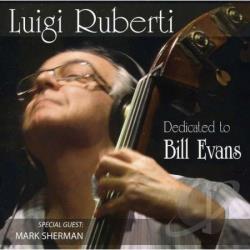
Luigi Ruberti
Dedicated To Bill Evans


by Marco Caiano
“Dedicated to ” è il titolo del nuovo album del compositore napoletano . L’album è stato presentato all’interno del salone della libreria “”, si tratta di un omaggiao alla musica jazz del grande pianista americano . Con la partecipazione di al contrabbasso, Pietro Santangelo al sax soprano, Francesco Marziani al pianoforte e Giuseppe la Pusata alla batteria, vengono riproposti i singoli di un grande del Jazz che, con la sua musica, ha accompagnato Ruberti nella crescita musicale. Musicista e didatta si avvicina alla musica giovanissimo iniziando al Conservatorio di Napoli. Il suo amore per il Jazz non lo limita e così si dedica ad altri generi senza però dimenticare mai la sua grande passione. Una carriera lunga venticinque anni nel corso della quale lavora a diversi progetti di sua composizione fino alla realizzazione del primo album nel 2005 con “Mosaico” e poi nel 2007 con “Sud a Levante”. Riproporre in “Dedicated to ” delle grandi musiche del pianista newyorkese, è il raggiungimento di una maturità, uscendo da schemi che ricordano i soliti sottofondi musicali.


Don Friedman Trio
Waltz For Debby


by Ken Dryden
This trio date led by Don Friedman is comparable to a typical Bill Evans session in several ways. Joined by bassist George Mraz and drummer Lewis Nash, one hears three strong musicians interacting rather than a rhythm section playing follow-the-leader with the pianist. Secondly, Friedman, like Evans, loves playing great melodies. Finally, Friedman is a gifted composer, though his pieces are obviously not as well known as Evans' works. But the comparison ends there, as Friedman has a distinctive style of his own. The title track is obviously Evans' best-known composition, though Friedman's interpretation of it is more aggressive and features a melodic solo by Mraz as well. Friedman's lyrical side is readily apparent in his warm rendition of Michel Legrand's bittersweet ballad "You Must Believe in Spring." The pianist is at his most adventurous skirting around the theme to Johnny Mandel's lovely "The Shadow of Your Smile," propelled by Mraz's phenomenal bassline until Nash is added and the setting of the piece is modified into a brisk samba. His originals merit attention as well. "35 W. 4th St." is a catchy post-bop theme, while the furiously paced "Blues in a Hurry" seems to catch the hustle and bustle of New York City. It's not surprising to learn that Friedman composed "Flamands" as a result of visiting the West Indies. Mraz takes the lead and has a prominent role throughout this infectious piece. "From A to Z" salutes his good friend, the late guitarist Attila Zoller, and includes an excellent drum solo by Nash. Friedman's closer is a breathtaking solo of Willard Robison's sentimental ballad "Old Folks." This intimately recorded studio session is an obvious keeper.


David Hazeltine Trio
Waltz For Debby

Waltz for Debby

by Ken Dryden
David Hazeltine is one of New York City's busiest jazz pianists and he has also attracted attention overseas, having recorded for a number of European and Japanese labels in addition to this work in the U.S. Producer Tetsuo Hara became particularly enamored with Hazeltine and has recorded him on a regular basis for his Venus label; this outing is a tribute to the great pianist/composer Bill Evans, recorded in late 1998. It's a challenge to play Evans' compositions without a certain degree of his influence in a piano trio setting, but that doesn't really matter, as the three musicians keep the music fresh, even if there is nothing innovative about their approach. Vetran bassist George Mraz is a veteran of many sessions as a sideman for Venus, and drummer Billy Drummond is also a first-call player, while both fit the mold of musicians who would have complemented Evans himself. Hazeltine never attempts to outright copy Evans' playing style, beginning with a breezy "Waltz for Debby" that percolates with energy. Ballads are always an acid test for jazz musicians, and Hazeltine's treatment of the bittersweet "Time Remembered" brings out the lyricism of this beautiful work. Mraz is showcased in good light in the challenging "Funkallero." Hazeltine has one solo feature, the intricate original "Bill at Peace," in which the late pianist's influence is readily apparent. The audio throughout this enjoyable session is superb, giving the listener the feeling of sitting a few feet away from the trio in the studio.


Danilo Perez
Across The Crystal Sea


by Doug Collette
Track Listing: 
Across the Crystal Sea; Rays and Shadows; Lazy Afternoon; The Purple Condor; If I Forget You; (All of a Sudden) My Heart Sings; The Saga of Rita Joe; Another Autumn. Personnel: 
Personnel: 
Danilo Perez: piano; Cassandra Wilson: vocals (3, 6); Christian McBride: bass; Lewis Nash: drums; Luis Quintero: percussion; Claus Ogerman: conductor, orchestra arranger.
During the course of their collaboration on Across the Crystal Sea, pianist Danilo Perez and arranger Claus German defy convention as much as they utilize it to their own ends. Like the colors in the cover painting at first seem like pastels, but upon close inspection reveal deeper tones, the contrast of the orchestration with a jazz ensemble led by the veteran pianist is symbiotic yet rife with surprise.
To merely describe this album as a trio plus strings will no doubt generate more than a little trepidation, even when mentioning the themes upon which the compositions are based come from classical composers. The fact is the two units involved on the project, though recorded separately, unite as one in the Tommy LiPuma-produced (and Al Schmitt-engineered) CD.
The appearance of vocalist Cassandra Wilson on two tracks, while not truly the highlight of the album, is fully integrated into the mood as well. Defining "(All of a Sudden) My Heart Sings" as a middle- of-the-road treacle is a simplistic interpretation of the concept this album might suggest, but a sensual quality eventually arises from the performance. "Lazy Afternoon" finds Wilson's voice likewise utilized as an instrument, so that it's notable the only clearly enunciated lyric she sings is the title phrase; elsewhere the rich presence of her voice appears to arise from the listener's heart, then goes into the head.
The perfectly languorous mood created in that cut is the first gentle crescendo that appears on the disc. Perez, currently a stalwart of Wayne Shorter's group and the trio including Lewis Nash on drums and Christian McBride on bass, play with perfect poise around which Ogerman's string arrangements wave and waft in similar slow motion. There's more than one echo of Jobim on the title song. Not because of the presence of percussionist Luis Quintero, but because the orchestration sways tenderly, in synchronous time with the small combo.
The sparse precise sound of piano, bass and drums is a perfect counterpoint and complement to the orchestra on pieces inspired by Massenet ("The Saga of Rita Joe"), Rachmaninoff ("If I Forget You") and Sibelius ("Rays and Shadows"). The noir atmosphere of a jazz club near closing time, intermingles with a tropical air as lush waves of strings thin and thicken in reciprocal rhythm.
There's little sense of any tension building whatsoever during the course of the eight tracks until "Another Autumn" seems to float to a close...only to reappear in a bright denouement that is the antithesis of the melancholy, usually associated with the fall season in all its metaphorical meaning. Thus, Across the Crystal Sea becomes both circular and cyclical, a rather remarkable piece of work created by two artists with their own distinct musical visions who find those traits they share to formulate a concept that is wholly unique on its own terms.


David Benoit
Letter To Evan


by Scott Yanow
David Benoit had a slight departure with this 1992 release, performing two previously unheard Bill Evans compositions ("Letter to Evan" and "Knit for Mary F."), Dave Brubeck's "Kathy's Waltz" and a mixture of standards and originals. Most of the tunes are played with small groups (duets to quartets) and such fine players as bassist John Patitucci, drummer Peter Erskine and guitarists Larry Carlton and Peter Sprague make strong contributions. The melodic and mostly straight-ahead music is pleasing, pretty and sometimes swinging, if not all particularly innovative. Worth checking out by jazz listeners.


Kenny Drew Jr.
Solo - This One's For Bill


By Flibbert J. Goosty
It is not difficult to measure how much influence the late Bill Evans has exerted over the young pianists of today. The impact of his playing can be heard, in varying degrees, in virtually every pianist that followed him. That's because he changed the way piano players approach the instrument, moving away from a strict bebop vocabulary, and bringing to fore the piano's inherent orchestral abilities through dense harmonies and sweeping melodic lines. Evans employed an introspective approach, gracefully caressing the keyboard with an uncommon subtlety not found in the bop pianists of the fifties. He used chord voicings that were at times ambiguous; he left it up to the to bassist to define the tonic. Evans' level of concentration at the keyboard could be mesmerizing. He would often be in a trance-like state as he allowed the piano to consume both his mind and his body. And although Bill Evans will be sorely missed, his spirit and his influence will be felt for decades to come, thanks in part to Kenny Drew Jr., a gifted and sensitive young pianist who has released this wonderful CD on the TCB Label, entitled This One's For Bill.
No stranger to jazz fans, Kenny Drew Jr. has released a dozen CD's under his own name, and is on countless others as a sideman. Well versed in the classical repertoire, Kenny has immense technique on his instrument, yet there is also a sensitivity and beauty that he exudes in his music. Kenny is quite capable of introspection and contemplation; it is for this very reason that this solo piano outing is so successful. Only in the hands of a master, can the orchestral capabilities of this instrument be fully realized. In this most intimate setting, Kenny clearly orchestrates for his instrument, embellishing each measure of each tune, with an wide array of tonal hues. And if a carefully built phrase, sweeping arpeggio, or mellow cascade of chords puts you in mind of Bill Evans, it's not necessarily your imagination.
Aside from the title cut, which is Kenny's personal tribute to the late Evans, the set of songs on this disc were either penned by Evans, or closely associated with him. Included is a beautiful rendition of "Nardis," a tune Bill played for many years. Although the actual composer of this song has been the subject of much controversy, the piece, with it's exotic melody line and quiet chords, has Bill Evans written all over it. Other highlights from the disc are the song "Suicide Is Painless"(which many will remember as the theme-song from the T.V. show M.A.S.H. ), and a crisp offering of Henry Mancini's "The Day Of Wine And Roses." This latest effort by Kenny Drew is a consistently rewarding CD to listen to, further documenting his continuous growth as a player, and serving to fortify his position as one of the premiere jazz pianists of the 21 century.