Saturday, June 25, 2011

Time Remembered - The 50th Celebration 1961-2011


June 25, 2011 - Brasilia, Brasil

By Leonardo Barroso
Four friends together (Claudio,Mateus,Lucius and Me) to celebrate music, to enjoy a masterpiece made 50 years ago. The Bill Evans Trio with Scott LaFaro and Paul Motian were together at the Village Vanguard on a Sunday, June 25, 1961.
It is consider to be one of the most influential jazz recording ever made, and the one that defines how a jazz-piano trio must sound. But for myself, is one the greatest music played, how can you not be moved by the great tune "My Foolish Heart"? It was a new way to hear this piece.
Tonight we heard a Bill Evans repertory, and started as listed below:
- Luigi Tessarollo & Stefano Bollani
- Eliane Elias, Joey Baron, Marc Johnson
- The Danish Radio Jazz Orchestra and Jim McNeely
- Kronos Quatet and Eddie Gomez
- Stefano Battaglia Trio
- Luca Lapenna
- The Drummonds
- JVC Portrait of Bill Evans: Eliane Elias, Brad Mehldau, Bob James, Dave Grusin, Herbie Hancock
Plus:
Bill Evans " You Must Believe in Spring"
The Tony Bennett/Bill Evans Album
Bill Evans The Complete Village Vanguard Recordings,1961


The night was wonderful and thanks to all my friends, and to all jazz fans in the World !!

Wednesday, February 23, 2011

Tribute Recordings on Bill Evans - Part Six

Luca Lapenna
Words For Evans


by Mr. Claudio Botelho
You’re right: this is one more homage to the great Bill Evans! There you have it: “My Bells”; “Turn out the Stars”; “Peri’s Scope”; “Only Child”; “One for Helen”; “The two Lonely People”; “Very Early”; “Time Remembered”; “Waltz for Debby”; “Another Time, Another Place” and a song named “Ending” which ends the recording.
Four of the Evans songs received lyrics from Lapenna himself (Peri’s Scope; Only a Child; One for Helen and Time Remembered), two others were penned by the bass player of the group (Another time, Another Place) and the remaining (Ending) was composed by Lapenna and his piano player.
Lapenna made it at the end of 1995, entering January of 1996. You’re wrong: this work is really from the middle nineties! There isn’t any misprint here!
- Hey, Claudio, we’re in 2011, come on! Don’t you think you’re a little late?
- No, I’m not: good music; honesty; sincere praise; sensible renderings; shivering emotions are atemporal subjects!
- Oh, man, there are some hundreds of homages like this…
- No, my friend, not LIKE this!
- Why not?
- ‘Cause you can feel all throughout the performances a deep emotional charge, a comprehensive understanding of that composer’s soul, a profound respect for the mood of each song; all this without any abdication of the jazz language, as we come to know and admire…
- Really?
- You bet, man, you bet! Lapenna’s diminutive voice, backed by some equally inspired musicians, did his best by overcoming his low register limitations, sometimes on the verge of ruining a song, other times trembling with emotion! The sparsely presentations give the listener a chance to enjoy everything: from his smallest intonations, to every music inflexions of his cohorts which, as a whole, merged in a unity of sublime identification with the soul of that composer…
- You’re kidding me, they aren’t even Americans!...
- You’re right: they are not, but they sported a deep admiration for Mr. Evans and their music spoke clearly of this. You can see this through the muted trumpet, across the delicate fingered piano or the work of the attentive bass and drums players.
- Wow!
- Yes, Wow! Thanks Luca Lapenna; thanks Paolo Fresu (tr. & fl); thanks Alberto Tacchini (p); Thanks Atillo Zanchi (b) and thanks Giampero Prina (d). Many thanks.
- So, let´s turn out the stars?
- We may try…


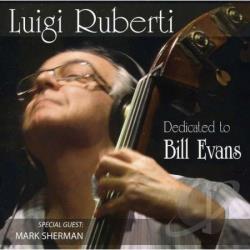
Luigi Ruberti
Dedicated To Bill Evans


by Marco Caiano
“Dedicated to ” è il titolo del nuovo album del compositore napoletano . L’album è stato presentato all’interno del salone della libreria “”, si tratta di un omaggiao alla musica jazz del grande pianista americano . Con la partecipazione di al contrabbasso, Pietro Santangelo al sax soprano, Francesco Marziani al pianoforte e Giuseppe la Pusata alla batteria, vengono riproposti i singoli di un grande del Jazz che, con la sua musica, ha accompagnato Ruberti nella crescita musicale. Musicista e didatta si avvicina alla musica giovanissimo iniziando al Conservatorio di Napoli. Il suo amore per il Jazz non lo limita e così si dedica ad altri generi senza però dimenticare mai la sua grande passione. Una carriera lunga venticinque anni nel corso della quale lavora a diversi progetti di sua composizione fino alla realizzazione del primo album nel 2005 con “Mosaico” e poi nel 2007 con “Sud a Levante”. Riproporre in “Dedicated to ” delle grandi musiche del pianista newyorkese, è il raggiungimento di una maturità, uscendo da schemi che ricordano i soliti sottofondi musicali.


Don Friedman Trio
Waltz For Debby


by Ken Dryden
This trio date led by Don Friedman is comparable to a typical Bill Evans session in several ways. Joined by bassist George Mraz and drummer Lewis Nash, one hears three strong musicians interacting rather than a rhythm section playing follow-the-leader with the pianist. Secondly, Friedman, like Evans, loves playing great melodies. Finally, Friedman is a gifted composer, though his pieces are obviously not as well known as Evans' works. But the comparison ends there, as Friedman has a distinctive style of his own. The title track is obviously Evans' best-known composition, though Friedman's interpretation of it is more aggressive and features a melodic solo by Mraz as well. Friedman's lyrical side is readily apparent in his warm rendition of Michel Legrand's bittersweet ballad "You Must Believe in Spring." The pianist is at his most adventurous skirting around the theme to Johnny Mandel's lovely "The Shadow of Your Smile," propelled by Mraz's phenomenal bassline until Nash is added and the setting of the piece is modified into a brisk samba. His originals merit attention as well. "35 W. 4th St." is a catchy post-bop theme, while the furiously paced "Blues in a Hurry" seems to catch the hustle and bustle of New York City. It's not surprising to learn that Friedman composed "Flamands" as a result of visiting the West Indies. Mraz takes the lead and has a prominent role throughout this infectious piece. "From A to Z" salutes his good friend, the late guitarist Attila Zoller, and includes an excellent drum solo by Nash. Friedman's closer is a breathtaking solo of Willard Robison's sentimental ballad "Old Folks." This intimately recorded studio session is an obvious keeper.


David Hazeltine Trio
Waltz For Debby

Waltz for Debby

by Ken Dryden
David Hazeltine is one of New York City's busiest jazz pianists and he has also attracted attention overseas, having recorded for a number of European and Japanese labels in addition to this work in the U.S. Producer Tetsuo Hara became particularly enamored with Hazeltine and has recorded him on a regular basis for his Venus label; this outing is a tribute to the great pianist/composer Bill Evans, recorded in late 1998. It's a challenge to play Evans' compositions without a certain degree of his influence in a piano trio setting, but that doesn't really matter, as the three musicians keep the music fresh, even if there is nothing innovative about their approach. Vetran bassist George Mraz is a veteran of many sessions as a sideman for Venus, and drummer Billy Drummond is also a first-call player, while both fit the mold of musicians who would have complemented Evans himself. Hazeltine never attempts to outright copy Evans' playing style, beginning with a breezy "Waltz for Debby" that percolates with energy. Ballads are always an acid test for jazz musicians, and Hazeltine's treatment of the bittersweet "Time Remembered" brings out the lyricism of this beautiful work. Mraz is showcased in good light in the challenging "Funkallero." Hazeltine has one solo feature, the intricate original "Bill at Peace," in which the late pianist's influence is readily apparent. The audio throughout this enjoyable session is superb, giving the listener the feeling of sitting a few feet away from the trio in the studio.


Danilo Perez
Across The Crystal Sea


by Doug Collette
Track Listing: 
Across the Crystal Sea; Rays and Shadows; Lazy Afternoon; The Purple Condor; If I Forget You; (All of a Sudden) My Heart Sings; The Saga of Rita Joe; Another Autumn. Personnel: 
Personnel: 
Danilo Perez: piano; Cassandra Wilson: vocals (3, 6); Christian McBride: bass; Lewis Nash: drums; Luis Quintero: percussion; Claus Ogerman: conductor, orchestra arranger.
During the course of their collaboration on Across the Crystal Sea, pianist Danilo Perez and arranger Claus German defy convention as much as they utilize it to their own ends. Like the colors in the cover painting at first seem like pastels, but upon close inspection reveal deeper tones, the contrast of the orchestration with a jazz ensemble led by the veteran pianist is symbiotic yet rife with surprise.
To merely describe this album as a trio plus strings will no doubt generate more than a little trepidation, even when mentioning the themes upon which the compositions are based come from classical composers. The fact is the two units involved on the project, though recorded separately, unite as one in the Tommy LiPuma-produced (and Al Schmitt-engineered) CD.
The appearance of vocalist Cassandra Wilson on two tracks, while not truly the highlight of the album, is fully integrated into the mood as well. Defining "(All of a Sudden) My Heart Sings" as a middle- of-the-road treacle is a simplistic interpretation of the concept this album might suggest, but a sensual quality eventually arises from the performance. "Lazy Afternoon" finds Wilson's voice likewise utilized as an instrument, so that it's notable the only clearly enunciated lyric she sings is the title phrase; elsewhere the rich presence of her voice appears to arise from the listener's heart, then goes into the head.
The perfectly languorous mood created in that cut is the first gentle crescendo that appears on the disc. Perez, currently a stalwart of Wayne Shorter's group and the trio including Lewis Nash on drums and Christian McBride on bass, play with perfect poise around which Ogerman's string arrangements wave and waft in similar slow motion. There's more than one echo of Jobim on the title song. Not because of the presence of percussionist Luis Quintero, but because the orchestration sways tenderly, in synchronous time with the small combo.
The sparse precise sound of piano, bass and drums is a perfect counterpoint and complement to the orchestra on pieces inspired by Massenet ("The Saga of Rita Joe"), Rachmaninoff ("If I Forget You") and Sibelius ("Rays and Shadows"). The noir atmosphere of a jazz club near closing time, intermingles with a tropical air as lush waves of strings thin and thicken in reciprocal rhythm.
There's little sense of any tension building whatsoever during the course of the eight tracks until "Another Autumn" seems to float to a close...only to reappear in a bright denouement that is the antithesis of the melancholy, usually associated with the fall season in all its metaphorical meaning. Thus, Across the Crystal Sea becomes both circular and cyclical, a rather remarkable piece of work created by two artists with their own distinct musical visions who find those traits they share to formulate a concept that is wholly unique on its own terms.


David Benoit
Letter To Evan


by Scott Yanow
David Benoit had a slight departure with this 1992 release, performing two previously unheard Bill Evans compositions ("Letter to Evan" and "Knit for Mary F."), Dave Brubeck's "Kathy's Waltz" and a mixture of standards and originals. Most of the tunes are played with small groups (duets to quartets) and such fine players as bassist John Patitucci, drummer Peter Erskine and guitarists Larry Carlton and Peter Sprague make strong contributions. The melodic and mostly straight-ahead music is pleasing, pretty and sometimes swinging, if not all particularly innovative. Worth checking out by jazz listeners.


Kenny Drew Jr.
Solo - This One's For Bill


By Flibbert J. Goosty
It is not difficult to measure how much influence the late Bill Evans has exerted over the young pianists of today. The impact of his playing can be heard, in varying degrees, in virtually every pianist that followed him. That's because he changed the way piano players approach the instrument, moving away from a strict bebop vocabulary, and bringing to fore the piano's inherent orchestral abilities through dense harmonies and sweeping melodic lines. Evans employed an introspective approach, gracefully caressing the keyboard with an uncommon subtlety not found in the bop pianists of the fifties. He used chord voicings that were at times ambiguous; he left it up to the to bassist to define the tonic. Evans' level of concentration at the keyboard could be mesmerizing. He would often be in a trance-like state as he allowed the piano to consume both his mind and his body. And although Bill Evans will be sorely missed, his spirit and his influence will be felt for decades to come, thanks in part to Kenny Drew Jr., a gifted and sensitive young pianist who has released this wonderful CD on the TCB Label, entitled This One's For Bill.
No stranger to jazz fans, Kenny Drew Jr. has released a dozen CD's under his own name, and is on countless others as a sideman. Well versed in the classical repertoire, Kenny has immense technique on his instrument, yet there is also a sensitivity and beauty that he exudes in his music. Kenny is quite capable of introspection and contemplation; it is for this very reason that this solo piano outing is so successful. Only in the hands of a master, can the orchestral capabilities of this instrument be fully realized. In this most intimate setting, Kenny clearly orchestrates for his instrument, embellishing each measure of each tune, with an wide array of tonal hues. And if a carefully built phrase, sweeping arpeggio, or mellow cascade of chords puts you in mind of Bill Evans, it's not necessarily your imagination.
Aside from the title cut, which is Kenny's personal tribute to the late Evans, the set of songs on this disc were either penned by Evans, or closely associated with him. Included is a beautiful rendition of "Nardis," a tune Bill played for many years. Although the actual composer of this song has been the subject of much controversy, the piece, with it's exotic melody line and quiet chords, has Bill Evans written all over it. Other highlights from the disc are the song "Suicide Is Painless"(which many will remember as the theme-song from the T.V. show M.A.S.H. ), and a crisp offering of Henry Mancini's "The Day Of Wine And Roses." This latest effort by Kenny Drew is a consistently rewarding CD to listen to, further documenting his continuous growth as a player, and serving to fortify his position as one of the premiere jazz pianists of the 21 century.

Turn Out The Stars:The Final Village Vanguard Recordings June 1980


By Doug Collette
The extent to which Bill Evans' studio and live recordings have been recorded, archived and released is a testament to the deserved reverence the late pianist has elicited. Originally available only in a limited run, Turn Out the Stars-The Final Village Vanguard Recordings June 1980 is further evidence of that devout respect.
Far more lavish (and sturdy despite the individual digipaks inside)) than the accompanying box, the essays written by Bob Blumenthal and Harold Danko are extensive in their detail and focused passion, as good a means of describing The Evans trio's own playing as there is. On “Re: The Person I knew,” there is no melodramatic lingering on the sweet melody, as if to telegraph its beauty rather a constant turn through its changes. If slowly rotating a fine jewel is the best way to appreciate its true beauty by viewing as many facets as possible--no one angle fully serves the purpose--so, too, is Evans and his trio's approach to a composition's melody and rhythm.
As with Evans' classic trio featuring drummer Paul Motian and bassist Scott LaFaro, the personnel at the time of these recordings--bassist Marc Johnson and drummer Joe LaBarbera--does its share to make descriptions about telepathic instrumental communication the cliché it is today. Hearing them interact on both renditions of “The Two Lonely People,” there is a sense of learning the contours of the composition a little better each time, as much as an increase in familiarity between the musicians. The former lesson is a means to the latter knowledge.
Describing musicians' interplay as conversation or dialogue is a clich&233; of sorts too, but in the case of Evans' trio it is perfectly appropriate throughout Turn Out the Stars. Each player makes his instrument take on characteristics of the other two. Johnson, for example, has as elegant a touch as Evans on “Nardis,” from the June 8 second set. Similarly the threesome shares the feel for each others' styles. LaBarbera moves with the same fleetness as Johnson, without any sense of hurry on “Time Remembered” from the June 6 second set
The breaks in the leader's playing on “Days of Wine and Roses,” from the June 5 second set, allow comments from his band mates on the preceding interval, sometimes constituting reiteration but more often representing extensions of thoughts just expressed. Each musician is confident enough in his own playing and that of his peers that he can afford to pause and reflect, if only for a split second, on what's just been played, to effectively process what he's just heard.
Given the stellar and staunch presence of Helen Keane and the Village Vanguard venue itself, it stands to reason that the recording here is as immaculate as the playing. The music contained in the six CDs of Turn Out the Stars: The Final Village Vanguard Recordings June 1980 demands to be preserved for posterity in exactly this splendid fashion.

By Nonesuch Records
Though these extraordinary 1980 recordings were made only months before pianist Bill Evans’s untimely death on September 15, 1980, at the age of 51, they capture a beginning far more than an end. At the time of their initial release in 1996, jazz critic Gary Giddins hailed them as “an important find—the most lyrical of improvisers was revitalized by a new trio in his favorite jazz club.” Fellow Village Voice writer Will Friedwald concurred: “Evans is as irrepressibly romantic as ever on these live recordings, but at the same time there’s an aggression to his playing that makes these newly discovered documents some of the most exciting music of his career ... he proves that he can really tear into the keyboard and still sound like Bill Evans. Continually prodded by [bassist Marc] Johnson and [drummer Joe] LaBarbera even as he's inspiring them, this is tenderness supported by strength and even bite.”
Evans had clearly found players to match his first trio from 20 years earlier, which had cut a landmark live recording at the Village Vanguard in 1961. That now-legendary lineup of bassist Scott LaFaro and drummer Paul Motion was shattered by the tragic death of LaFaro in a car crash. A sense of history and a feeling of renewal inform these 1980 sessions, and they illustrates the serious chemistry between Evans and his young accompanists. As pianist and friend Hank Danko recalls in his liner-notes essay, “When the trio lit into its ensemble passages, the impact was not unlike that of a roaring big band. This exuberant, extroverted and joyful approach extended to most of the material played, with Bill seeming, at times, to be its most youthful member.”
The performances on these six CDs—which feature both newly written originals and interpretations of the standards that Evans loved—were recorded on the evenings of June 4, 5, 6, and 8, 1980. Evans intended to release a double LP culled form these sessions, and he supervised the initial mixing and editing of the tapes. It would take more than 15 years before this material would become available, in an exhaustive, chronologically sequenced six-CD form, on the Warner Brothers label. This Nonesuch reissue contains the original packaging and liner notes, as well as the complete 1996 set.
Turn Out the Stars was released at a time when many other posthumous Evans recordings, both official and bootleg, were surfacing on CD. This was the one that critics agreed was essential. The Los Angeles Times urged readers to experience the collection “as a series of complete club sets, with the music ebbing and flowing from piece to piece.” Evans, the newspaper noted, “was constantly in a state of quest, perpetually in search of an elusive musical goal, and—from his own point of view—never quite achieving it. The opportunity to share, even indirectly, in that quest is what, for the discerning listener, makes Evans’s music so endlessly intriguing.”

MUSICIANS
Bill Evans, piano
Marc Johnson, bass
Joe LaBarbera, drums

PRODUCTION CREDITS
Recorded at the Village Vanguard, New York City, June 4-8, 1980
Produced for release by Jeff Levenson and Bill Kirchner
Executive Producer: Matt Pierson
Production Coordinator: Dana Watson
Original sessions produced by Helen Keane
Original location recording, remix, and digital mastering: Malcolm Addey
Original recording assistant: Jon Bobenko
Recorded June 4, 5, 6, 8, 1980, at the Village Vanguard, NYC
Originally released in 1996
Art direction: Mark Larson

Track Listing:
CD1: Bill's Hit Tune; Nardis; If You Could See Me Now; The Two Lonely People: Laurie; My Romance; Tiffany; Like Someone In Love; Letter To Evan.
CD2: Days Of Wine And Roses; Emily; My Foolish Heart; Nardis; Yet Ne'er Broken; Quiet Now; But Not For Me; Spring Is Here; Autumn Leaves.
CD3: Your Story; Re: Person I Knew; Polka Dots And Moonbeams; Two Lonely People, The; Theme From M*A*S*H; Tiffany; Turn Out The Stars; Laurie; My Romance; Knit For Mary F.; Midnight Mood; Time Remembered.
CD4: Days Of Wine And Roses; Up With The Lark; Nardis; Your Story; Yet Ne'er Broken; If You Could See Me Now; Bill's Hit Tune; Tiffany; In Your Own Sweet Way.
CD5: I Do It For Your Love; Five; Polka Dots And Moonbeams; Bill's Hit Tune; Turn Out The Stars; Days Of Wine And Roses; But Not For Me; Knit For Mary F.; Like Someone In Love; Quiet Now.
CD6: Emily; Nardis; Knit For Mary F.; Like Someone In Love; Letter To Evan; Minha; A Sleepin' Bee; My Romance/Five.
Personnel: Bill Evans: piano; Marc Johnson: bass; Joe LaBarbera: drums.
Nonesuch Records - Reissue

Sunday, November 28, 2010

Emulating Bill Evans - By Doug Ramsey

Emulating Bill Evans
By Doug Ramsey

Wall Street Journal - September 14, 2010

Regardless of style, era or instrument, the greatest jazz artists share an essential attribute: recognizability. Individualists like Louis Armstrong, Art Tatum, Artie Shaw, Charlie Parker, Miles Davis, John Coltrane and Bill Evans announce themselves. Their tone, phrasing, touch, harmonic choices and rhythmic turns are calling cards.
Generations of pianists have tried to copy the jazz legend's style.
Among pianists, Evans, who died 30 years ago Wednesday at age 51, is as immediately identifiable as Tatum, Earl Hines, Teddy Wilson and Bud Powell. In artistry and influence, he is their inheritor and successor. With the exception of those who specialize in stride or boogie woogie, virtually all jazz pianists who developed from the early 1960s on learned from Evans and, if they could, adapted aspects of his playing. In the second volume of "The Harmony of Bill Evans" (Hal Leonard Corp.), pianist and composer Jack Reilly writes that "he changed the approach to the sound of jazz piano by his touch and his attention to pedaling, phrasing and dynamics." He emphasizes Evans's "remarkable way of handling the possibilities of interplay within the piano-bass-drums trio." Mr. Reilly's books are how-to manuals for musicians with the chops and ears to employ Evans's innovations.
Evans's invention of melodies puts him in a league with Chopin, Schubert and Gershwin, his wizardry with chords in a league by himself. He admired harmonic aspects of Lennie Tristano and Dave Brubeck, but no one in jazz before Evans voiced chords and moved through harmonies as he did.
Thirty years after his death on Sept. 15, 1980, Evans is omnipresent in a range of pianists that includes Herbie Hancock, Keith Jarrett, Fred Hersch, Jessica Williams, Billy Childs, Bill Mays, Denny Zeitlin, Larry Willis and—this is not a stretch—hundreds of others. His uses of chords influence not only players of every instrument but also the work of composers and arrangers. They were a major factor when Evans collaborated with Miles Davis in the celebrated "Kind of Blue" album in 1959.
Evans pioneered a way of opening up harmonies—his so-called "rootless" chords—that freed his bassists to interact above, below, in and around his piano playing. A CD called "Tenderly: An Informal Session" (Milestone) includes a snippet of conversation in the mid-'50s following Evans's spontaneous duet with the multi-instrumentalist Don Elliott.
Evans: "I like to blow free like that, with no 'four' going, but you know where you're at. It's crazy. If everybody could do that, if the bass could be playing that way—why not?—drums could just . . ." (He vocalizes in imitation of a drummer playing free.)
Elliott: "That's right; doesn't have to help you."
Evans: "Not if everybody feels it, man."
Finally, in 1959 Evans formed a trio with bassist Scott LaFaro and drummer Paul Motian, who felt what Evans had been hearing in his mind for years. Their albums, notably "Portrait in Jazz," "Explorations" and "Sunday at the Village Vanguard" (all for the Riverside label), set new levels of aspiration for pianists and new standards for interaction in jazz-piano trios.
Regiments of young bassists imitate LaFaro's ability to play high and fast, but most do not or cannot begin to approximate his lyricism, timing or depth of tone, which Evans likened to the sound of an organ. Many new bassists emulate the technique they hear from LaFaro on the Evans recordings without understanding how it fits into the complex relationship among Evans, LaFaro and Mr. Motian. They miss how LaFaro's note choices relate to the impressionistic chord voicings that give Evans's playing so much of its character. Worse, they overlook at least half of what made LaFaro a great bassist: the power of his straight-ahead swing, which meshed with Evans's own rhythmic concept.
In July 1961, less than two weeks after the trio recorded at the Village Vanguard, LaFaro died in a car crash at the age of 25. His death sent Evans into depression so deep that, according to Mr. Motian, he did not perform for six months. Gene Lees, a close friend of Evans, wrote in his book "Meet Me at Jim & Andy's" (Oxford), "After LaFaro's death, Bill was like a man with a lost love, always looking to find its replacement." Evans's bereavement over LaFaro affected him the rest of his life, but he went back to work with Mr. Motian and a new bassist, Chuck Israels. In succeeding trios, Eddie Gomez and Marc Johnson—virtuosi heavily influenced by LaFaro—had the bass chair. Evans recorded, unaccompanied and with others, for nearly two more decades.
Pegging Evans as an introspective, withdrawn musician is a cliché of jazz criticism, but from the beginning there was muscle and grit in his playing. That is evident in recordings early in his career with George Russell's sextet on "Concerto for Billy the Kid" (The George Russell Smalltet, Bluebird) and a large Russell band on "All About Rosie" (Brandeis Jazz Festival, Gambit).
The loss of his beloved brother Harry in 1979 sent Evans into another period of depression, but toward the end his assertive qualities intensified. In "Consecration" (Milestone), a set of eight CDs recorded at the Keystone Korner in San Francisco, his playing with Mr. Johnson and the remarkable drummer Joe LaBarbera is full of fire. Suffering from illness complicated by his long, dogged affair with drugs, he may have known that he was dying. Evans's final recorded piece, from Sept. 9, 1980, is Rodgers and Hart's "My Romance," a staple of his repertoire. With his breathtaking introduction, the playful accompaniment of Messrs. LaBarbera and Johnson, and the group's spirited three-way conversation, it is not a death rattle, but a life-affirming shout.
In New York six days later, Bill Evans was gone.
Mr. Ramsey is a winner of the Jazz Journalists Association Lifetime Achievement Award. He blogs about jazz and other matters at www.dougramsey.com

Monday, November 8, 2010

Top 10 Bill Evans Band Member

Caros amigos du JAZZ,

Segue resultado dos TOP 10 Bill Evans Band Member:


Paul Motian

Eddie Gomez

Chuck Israels

Marc Johnson

Claus Ogerman

Scott LaFaro

Joe LaBarbera

Jim Hall

Eliot Zigmund

George Russell

Friday, November 5, 2010

THE BIG LOVE: Life and Death with Bill Evans

"The Big Love: Life and Death with Bill Evans" - by Laurie Verchomin
Laurie Verchomin, Bill Evans' girlfriend and last muse( the song "Laurie" was written for her), with whom he lived in the final years of his life(1979-1980). This new book is all about the moments between Laurie and Bill, and is now available on her website. Laurie is offering a special Collector's Edition of the book, with a beautiful reproduction of a drawing"the Island"that Bill did. There is a video, on which she decribes all about this release (and how to buy the book with or without the drawing), at her website.

Sunday, September 26, 2010

Tribute Recordings to Bill Evans - Part Five

Monica Zetterlund
Bill Remembered - A Tribute to Bill Evans

Cover (Bill Remembered:Monica Zetterlund)


By Monica Zetterlund (1937-2005) written in 2000 for the CD.
Just think of it.....36 years have gone by since I recorded the album "Waltz For Debbie" with Bill Evans. The fact that he's been gone for 20 years is also difficult to grasp. I remember hearing him for the first time at Birdland in New York. It was 1959 and I had never heard a pianist like him. His playing was so beautifully lyrical, and yet so deceptively simple, economic and intricate at the same time. For that reason this recording is a loving homage to Bill. He played many of these songs from time to time himself. I'm singing from the heart, not from a technical aspect, because the voice undergoes changes with the passing of years. In the past I used to sing more or less everyday in different circumstances: theatre, concerts, film, radio, TV and records and consequently, I could keep my voice in trim, but now several months can go by when I don't sing at all, I'm not the type who goes around humming to myself everyday, not even in the shower. I only sing if I really have to, the reason being that the voice undergoes as much wear-and-tear as the rest of the body - they go hand-in-hand and my body has really been subjected to much physical strain over the years. That's why I sat at home in my armchair to make this CD, singing to the background accompaniments which Goran, Ulf and Brent have arranged so skilfully after our collective-discussions that we had during the summer and autumn of 1999, and which all the musicians interpret with such sensitivity and feeling. THIS WILL BE MY LAST RECORDING - AND SO FOR THAT REASON I WOULD LIKE TO DEDICATE IT TO BILL.


Eliane Elias
Something For You - Eliane Elias Sings & Plays Bill Evans

Cover (Something for You: Eliane Elias Sings & Plays Bill Evans:Eliane Elias)


by Ken Dryden
Eliane Elias' return to the Blue Note label after a decade working elsewhere is a triumph. This salute to the late pianist
Bill Evans, one of her favorite players, explores a number of songs he recorded, including both standards and originals. Evans' bassist from his final trio, Marc Johnson, is not only a long-time collaborator with Elias but also her husband; drummer Joey Baron rounds out the band. While Elias is influenced by Evans' playing style, his arrangements are only a launching pad for her approach to each tune; never does she sound like an obvious Evans clone. Her lush take of "My Foolish Heart" features Johnson on the late Scott LaFaro's bass (the talented Evans sideman who died in a 1961 car wreck just ten days after recording the landmark sets with the pianist at the Village Vanguard). "Evanesque" is a newly discovered work that came from a cassette given to Johnson by Evans, so Elias adjusted the work by incorporating new material with his conception. The freewheeling take of "Solar" is a masterful group improvisation upon the Miles Davis theme. Elias' moving ballad "After All" is a sincere tribute to Evans. She has also built confidence in her singing over time; always gifted with a tender, sensuous voice, Elias glides gently over Johnson's walking introduction to "A Sleepin' Bee" and offers an equally delicate "Walt for Debby." She wrote words to Evans' previously unknown "Here Is Something for You," which was also discovered on the cassette given to Johnson. It is heard in two versions, a solo version with voice and piano where Elias mostly closely mirrors Evans' playing, then the original rehearsal by Evans, which segues into an excerpt of Elias' new version. The Japanese version of this delightful CD features an added track, "Re: Person I Knew."


Jean-Yves Thibaudet
Conversations with Bill Evans

Cover (Conversations with Bill Evans:Jean-Yves Thibaudet)

By Leonardo Barroso
For me the best tribute ever made for Bill Evans or for anyone. Beautiful, lyrical, profund and solo piano. Made by one of the most aclaimed classical pianist Jean-Yves Thibaudet. A must have for every jazz and classical fan. Evers since in his concert, he plays an Evans song at the finale of his presentation. I call this album: Alone part 3 or Final Conversations. Five stars !!!
THIS IS THE BEST TRIBUTE ALBUM EVER RECORDED !!!!!


by Richard S. Ginell
This was an inevitable record, the absorption of Bill Evans into the classical music world by having a concert pianist play his music. After all, the classical piano streams of Debussy, Ravel and Rachmaninoff, among others, do lead straight into Evans' introspective side. The only problem, perhaps, was in finding a major classical pianist who is open-minded and courageous enough to take this music on -- and they found one in Jean-Yves Thibaudet, a young virtuoso from Lyons, France who also happens to be Decca/London's most heavily promoted pianist of the '90s. What happens here, though, is the antithesis of jazz, where the notes from spontaneous improvisations are canonized as the Holy Word, not to be tampered with. Reading from carefully selected transcriptions of Evans' solos, Thibaudet applies all of the tools in a classical pianist's arsenal -- the expressive tempo fluctuations, carefully terraced dynamics, a lovely, singing, rounded tone, subtle pedaling -- and produces broad, seductively rhapsodic interpretations that could comfortably cap off an enlightened classical recital. "Peace Piece," tin particular, could almost be mistaken for a long-lost Satie Gymnopedie. What Thibaudet misses, though, is true jazz feeling; when he tries to kick it in, as in the middle of "Here's That Rainy Day," the syncopation sounds boxy and unnatural. He is, however, adventurous -- or perhaps literal -- enough to follow Evans' example and overdub reductions of Evans' added piano parts to "Love Theme From 'Spartacus'" and "Song for Helen." This is an undeniably beautiful record, one that may contribute to Evans' credibility in classical circles, but one must turn to Evans' own recordings for the authentic sound and feeling.


Eliane Elias, Brad Mehldau, Bob James, Herbie Hancock, Dave Grusin
Portrait Of Bill Evans

Cover (Portrait of Bill Evans:Bob James)

by Leonardo Barroso
A tribute ordered by JVC, and who said Brad Mehldau wasn't inspired by Bill Evans ? Each musician plays two tunes by Bill, associated with , or a true homage. Superberly well recording, made with JVC XRCD
24-Bit technology.
Eliane Elias plays Come Rain or Come Shine and If You Could See Me Now
Bob James plays Nardis and Under The Influence
Herbie Hancock plays Gotta Rhytm and Ghost Story
Brad Mehldau plays The More I See You and My Heart Stood Still
Dave Grusin plays Waltz For Debby and Emily


Paul Motian
Bill Evans - Tribute To The Great Post-Bop Pianist

Cover (Bill Evans: Tribute to the Great Post-Bop Pianist:Paul Motian)


by Stephen Cook
Having been Bill Evans' drummer during the pianist's prime early-'60s period, Paul Motian is the right person to record an Evans tribute album, a recording that fits right in with Motian's spate of jazz repertory releases (Monk in Motian, the On Broadway series). But the obligatory nature of the record ends there, as Motian, tenor saxophonist Joe Lovano, guitarist Bill Frisell, and bassist Marc Johnson turn in an innovative set, using Evans' rich harmonic and rhythmic structures to launch many inspired solos. And being sensitive to Evans' subtle and intimate piano style, the group opts for a fairly straightforward tonal attack: Frisell forgoes his usual hyper-eclectic approach for some unadorned jazz soloing, while Lovano sticks to the middle register of his horn. For his part, Motian keeps the swing supple enough to be unobtrusive, while adding choice accents throughout. Highlights include the exquisite ballads "Turn Out the Stars" and "Very Early," a somewhat free-form reading of "Five," and the elegiac rendition of "Play Song." This is one of the best releases of the handful Motian has done with Lovano and Frisell, and certainly as fine a tribute record as there is. A good purchase for fans of both Bill Evans and Paul Motian.