Tuesday, January 3, 2017

Bill Evans - Some Other Time: The Lost Sessions From The Black Forest

Some Other Time: The Lost Sessions From The Black Forest


By Mark Richardson Executive Editor
Some Other Time is a newly unearthed Bill Evans studio album, initially recorded in 1968 in Germany but not released until this month. It still sounds fresh and alive almost 50 years later.
Casual jazz fans know Bill Evans through his association with Miles Davis. Kind of Blue, the one jazz album you own if you only own one, features Evans on piano on four of the five tracks, and his brief liner notes sketch out the group's approach to improvisation in poetic and accessible terms. When you learn a bit more about Kind of Blue, you learn that Davis actually envisioned the record with Evans in mind. And though for years Davis was listed as the album's sole composer, Evans wrote "Blue in Green" (he eventually received credit.)
Another Kind of Blue piece, "Flamenco Sketches," was partly based on Evans' arrangement of "Some Other Time," the Leonard Bernstein standard. (Evans had earlier used the slow opening vamp as a building block to his breathtaking solo piano composition "Peace Piece"). So though he may not be an especially famous jazz musician, Bill Evans played an integral role in shaping the most famous jazz recording of all time, and the arc of his discography is a rewarding one for those branching off from classic Miles. "Some Other Time" continued to be a touchstone piece for Evans for the rest of his life, appearing regularly on his albums (notably on his duet record with Tony Bennett). And now it's become the title track to a newly unearthed studio album, one recorded in 1968 in Germany but not released until this month.
Jazz in general overflows with archival material. It's a live medium, and recordings of shows have been common since the early part of the last century. Studio LPs could typically be cut in a couple of days, which generally meant a wealth of unused songs and outtakes. But it's somewhat rare to have a true unreleased album—a collection of songs recorded together at a session with the thought of a specific release that never saw the light of day.
Some Other Time: The Lost Session From the Black Forest is one of these. It was recorded when Evans was on tour in Europe with a trio that included Eddie Gomez on bass and, on drums, a young Jack DeJohnette, who would go on to much greater fame with Miles Davis, Keith Jarrett, and as a leader himself. It was cut between stops on a European tour by German producer Joachim-Ernst Berendt, with the idea that the rights and a release plan would be figured out later. This particular group had only been documented on record just once, on At the Montreux Jazz Festival, recorded five days prior to this date. So the existence of an unheard studio album by the trio is a significant addition to the Evans story.
The piano/bass/drums trio setting is where Evans did his most important and lasting work. He thrived on both the limitations and the possibilities of the set-up, and returned to it constantly over the course of his quarter-century recording career. He generally favored truly collaborative improvising in the setup; the bassist in his trio was expected to contribute melodically and harmonically, in addition to rhythmically, and he could often be heard soloing alongside the pianist. Eddie Gomez, heard on this album, was a steady partner of Evans' for a decade, and the level of empathy between the two players is something to behold. On "What Kind of Fool Am I?," Gomez's dancing lines darts between Evans' bass notes, almost serving as a third hand on the piano. On the immortal title track, Gomez seems like half a conversation, accenting and commenting on Evans' melodic flourishes. For his part, DeJohnette offers tasteful and low-key accompaniment, heavy on the brushwork and soft textures on cymbals—he was more of a role-player at this point in his career. But the three together feel like a true unit.
The tracklist on Some Other Time is heavy on standards, with a few Evans original sprinkled in. To love the American songbook is to be in love with harmony, and Evans never stopped discovering new possibilities in old and frequently played songs. He had a way of phrasing chord progressions for maximum impact, and he used space as virtually another instrument. Evans recorded "My Funny Valentine" many times in a number of different arrangements, often uptempo, but here he drags it out into an achingly poignant ballad that picks up speed as it goes. In his autobiography, Miles Davis famously described Evans' tone as sounding like "like crystal notes or sparkling water cascading down from some clear waterfall," and the tumble of notes on the faster sections of "My Funny Valentine" evince that crystalline loveliness. In addition to the material planned for the original LP, there's a second LP of outtakes and alternate versions that feels very much on par with the first disc.
Evans' art has endured in part because he has a brilliant combination of formal sophistication and accessibility; critics and his fellow musicians heard the genius in his approach to chords, his lightness of touch, and his open-eared support of others in his band, while listeners could put on his records and simply bask in their beauty, how Evans' continual foregrounding of emotion made the sad songs extra wrenching and the happy ones extra buoyant. He was sometimes criticized for an approach that could sound like "cocktail piano," meaning that it wasn't terribly heavy on dynamics and tended to be lower key and generally pretty, but this turned out to be another strength. If you wanted jazz in the background while engaging in another activity, Evans was your man, and if you wanted to listen closely and hear a standard like "Some Other Time" pushed to the limits of expression by his ear for space, he was there for that too.
Evans was one of those jazz artists who changed relatively little over the course of their career. His style developed and his sound had subtle shifts in emphasis over time, but his general approach to music was remarkably consistent, and he remained apart from most of the fashionable trends that wound through the jazz of his era. His first studio date as a leader, in 1956, was just a year after Charlie Parker's death, with bebop very much still au courant; his last, in 1979, the year before his death, was the year Chuck Mangione was nominated for a Grammy for the discofied light jazz funk of "Feels So Good." In both of those years, Evans recorded small-group acoustic jazz albums featuring his standard trio, playing a mix of standards and a few originals. About midway between those two bookends came this set, recorded in a small studio in Germany and left on the shelf, and it still sounds fresh and alive almost 50 years later.

Saturday, December 13, 2014

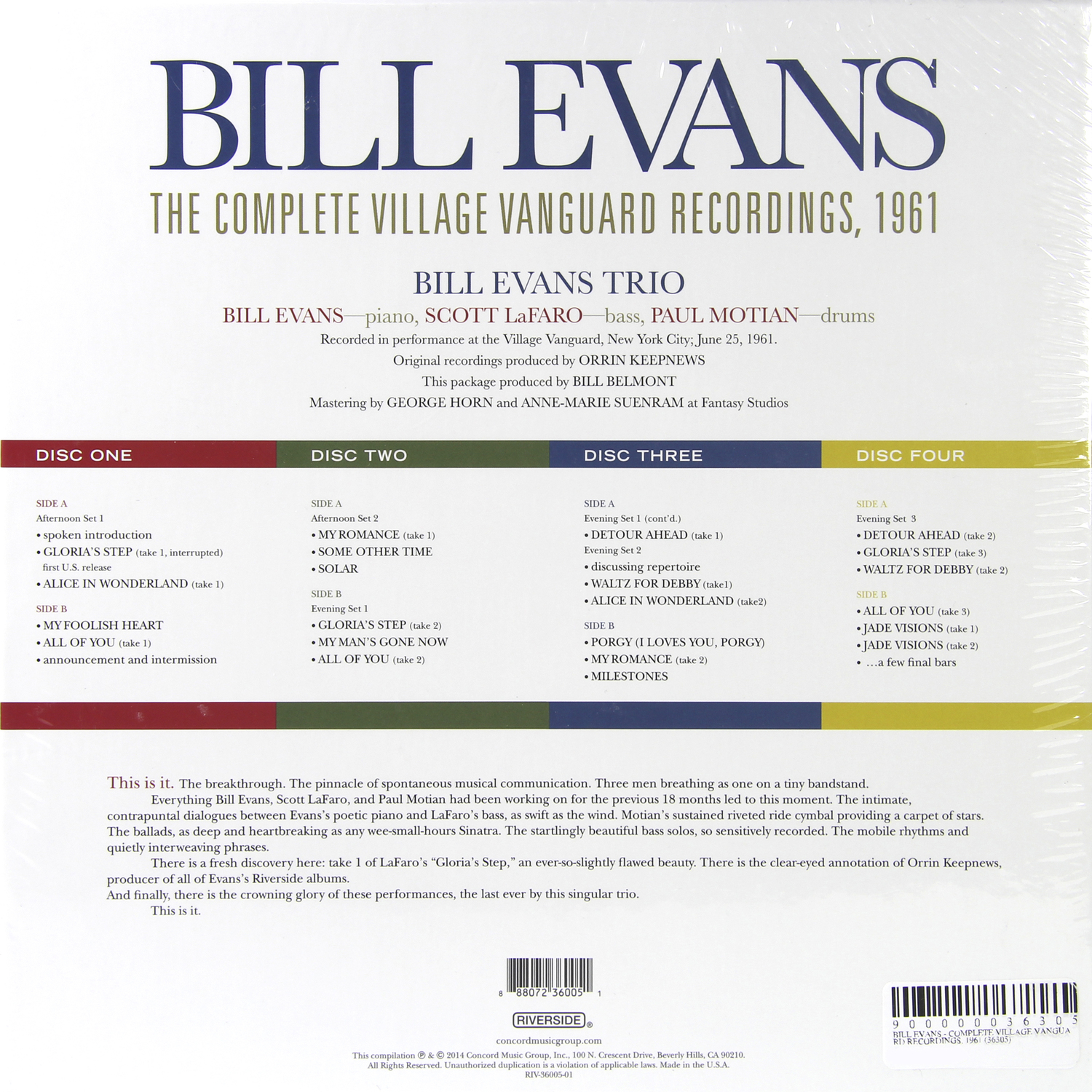
Bill Evans - The Complete Village Vanguard Recordings, 1961 (The Vinyl Box Set)


By Concord Music Group 

Concord Music Group is proud to announce the forthcoming vinyl reissue of Bill Evans’ The Complete Village Vanguard Recordings, 1961, one of the greatest live jazz recording sessions of all time. Pressed on 180-gram vinyl, the four-LPs box set is packaged with a 12-page booklet, complete with new liner notes by reissue producer Bill Belmont, as well as the original liner notes by the producer of the initial recordings, Orrin Keepnews. Reproductions of Keepnews’ session annotations and photographer Steve Schapiro’s proof sheets from the performances add vintage context to the packaging. As a bonus, a stunning metallic and black poster of the famous cover—Evans, in profile, deep in concentration at his piano—completes the box set.
Ranked time after time as one of the best live jazz recording sessions in history, and yielding two of Evans’ most classic albums (Waltz for Debby, Sunday at the Village Vanguard),The Complete Village Vanguard Recordings, 1961 represents the pinnacle of spontaneous musical communication: three men breathing as one on a tiny bandstand. The performances on these LPs demonstrate a new and more interactive approach to playing as a trio, one in which all instruments carry melodic responsibilities and function as equal voices. Keepnews recalls in his liner notes that “from the very first moments of the recording, it was impossible to ignore the importance of these performances.”
Everything Bill Evans, Scott LaFaro, and Paul Motian had been working on for the previous 18 months led to this moment on June 25, 1961. The little-known pianist and his trio performed afternoon and evening sets that Sunday to a small audience that unknowingly sat through what would become a very famous—and final—set by the trio (the 25-year old LeFaro died tragically in a car accident just days later). These recordings provide something of a sonic time capsule: sequenced in the original order of the five sets, the audience’s murmurings and applause are peppered throughout; even an interrupted take is left intact. Belmont recalls the process of piecing the performance back together during the remastering process: “As was the practice with early live recording, the songs [on the original album] were faded just after the last note, and much, if not all, of the audience and banter from the stage was removed. So the first stage of the process was to find the reels—if they existed—and try and make a reconstruction of everything that was recorded…The task was to try to make the show flow as closely as possible to what had been recorded.”


By Jeff Tamarkin at JazzTimes 

Concord Music Group is reissuing Bill Evans’ The Complete Village Vanguard Recordings, 1961, as a vinyl box set. Pressed on 180-gram vinyl, the four LPs are packaged with a 12-page booklet, complete with new liner notes by reissue producer Bill Belmont, as well as the original liner notes by the producer of the initial recordings, Orrin Keepnews. The set also includes reproductions of Keepnews’ session annotations and photographer Steve Schapiro’s proof sheets from the performances. As a bonus, according to a press release, a metallic and black poster of the album cover—Evans, in profile, deep in concentration at his piano—completes the box set.
The original recording was made June 25, 1961, at the New York venue and features pianist Evans with bassist Scott LaFaro and drummer Paul Motian.
Concord also plans a 12-disc reissue of The Complete Riverside Recordings for early 2015. That set presents all 20 recording sessions from the eight-year period (1956-63) that launched Evans’ career. These 151 performances are presented in what’s described as “a sleek brick box,” along with a 32-page illustrated booklet. Due in January is the four-LP set The Complete Tony Bennett/Bill Evans Recordings, which encompasses the duets Bennett and Evans recorded in 1975 and 1976. New liner notes by music critic and co-author of Bennett’s autobiography, Will Friedwald, complete the package.

Track Listing for The Complete Village Vanguard Recordings, 1961:
Disc 1
Side A: 
1. Spoken Introduction 00:43 
2. Gloria's Step (Take 1, Interrupted) 5:41 
3. Alice In Wonderland (Take 1) 6:57
Side B: 
1. My Foolish Heart 4:55 
2. All Of You (Take 1) 8:14 
3. Announcement And Intermission 1:44
Disc 2
Side A: 
1. My Romance (Take 1) 7:11 
2. Some Other Time 5:02 
3. Solar 8:57
Side B: 
1. Gloria's Step (Take 2) 6:10 
2. My Man's Gone Now 6:21 
3. All Of You (Take 2) 8:29 
Disc 3
Side A: 
1. Detour Ahead (Take 1) 7:17 
2. Discussing Repertoire 00:31 
3. Waltz For Debby (Take 1) 6:46 
4. Alice In Wonderland (Take 2) 8:31
Side B: 
1. Porgy (I Loves You, Porgy) 6:09 
2. My Romance (Take 2) 7:26 
3. Milestones 6:31 
Disc 4
Side A: 
1. Detour Ahead (Take 2) 7:41
2. Gloria's Step (Take 3) 6:48 
3. Waltz For Debby (Take 2) 7:00 
Side B: 
1 All Of You (Take 3) 8:18 
2. Jade Visions (Take 1) 4:12 
3. Jade Visions (Take 2) 3:57 
4. ...A Few Final Bars 1:15

Sunday, September 21, 2014

Martin Wind's Homage to Bill Evans

Martin Wind Quartet & Orchestra Filarmonica Marchigiana
Turn Out The Stars: Music Written or Inspired by Bill Evans


By Mark Corroto
Has an artist ever been characterized as a hopeful romantic? If not, then let us nominate Martin Wind, not as hopeless, but a bullish and inspiring romantic. His quartet and the 36- piece Orchestra Filarmonica Marchigiana tribute to pianist Bill Evans Turn Out The Stars marries his talents, both as a jazz bassist/bandleader and orchestral arranger.
Besides leading his own quartet, and working in trio with Bill Mays and Matt Wilson, and in the guitar/bass duos with Philip Catherine or Ulf Meyer, Wind is an in-demand sideman featured in multiple projects, including Matt Wilson's Arts & Crafts and bands led by, Ted Nash, Gary Smulyan, and Pete Mills, to name just a few. He released two stellar recordings in 2013, the CD Ulf Meyer and Martin Wind At Orpheus Theater (Laika) and an audiophile LP Remember October 13th (Edition Longplay).
Recorded live at the Theatro Rossini in Pesaro, Italy, Wind's quartet includes his regular partners, saxophonist Scott Robinson and pianist Bill Cunliffe, plus drummer Joe LaBarbera, who was Bill Evans' drummer in the pianist's final trio (1978-1980). This homage to Evans is enhanced by the gorgeous and passionate arrangements Wind wrote for conductor Massimo Morganti's orchestra. The disc opens with the title track, an overture in full bloom that gives way to the quartet's recitation of melody with Robinson's saxophone laying down velvety notes. Each piece— such as the spry rendition of "The Days Of Wine And Roses," performed by the quartet or full orchestra—is dexterously accomplished. Wind has the knack for extracting the sweetest juice for each piece written by Evans or written in tribute to the great one. La Barbera's composition "Kind Of Bill" opens with a piano and bowed bass duo, then lingers in that romantic atmosphere Evans loved to reach for.
Even in full orchestra, the quartet is never overwhelmed. The luscious arrangement of "Blue In Green" plays off of the contrasts of lightness and dark, the orchestra a pastoral landscape for the quartet to rollick. The tricky "Twelve Tone Tune Two" pushes the orchestra into a challenging interchange with La Barbera's drums and the coughing horn of Robinson. At the center of this gorgeous evening is the stalwart bass of Wind, the infrastructure upon which both a quartet and a very large orchestra is held by his passionate zeal.
Track Listing:
Turn Out The Stars; My Foolish Heart; The Days Of Wine And Roses; Jeremy; Memory Of Scotty; Kind Of Bill; Blue In Green; Twelve Tone Tune Two; Goodbye Mr. Evans.
Personnel:
Martin Wind: bass; Scott Robinson: tenor saxophone, C melody saxophone; Bill Cunliffe: piano; Joe La Barbera: drums; Orchestra Filarmonica Marchigiana - Massimo Morganti: conductor.

Saturday, June 14, 2014

Bill Evans Trio - LeJazz/Charly From the 90's

Bill Evans
Serenity


Bill Evans envisioned a piano trio in which the bassist and drummer wouldn’t be accompanists but equal participants. Further, without any attempts at obvious fusion, he melded elements of late 19th- and early 20th-century classical music into his approach, along with a quiet but powerful lyrical quality still based in jazz. SERENITY captures a live Evans radio broadcast with his regular bandmates from the early and mid-‘70s--Eddie Gomez (bass) and Marty Morell (drums)--performing Evans's best-loved favorites such as "Re: Person I Knew" and "Waltz For Debby."


The Bill Evans Trio
Quiet Now


By Stewart Mason
An aptly titled album from the Bill Evans Trio, Quiet Now is the jazz pianist at his most ambient and cerebral. Accompanied only by the minimalist rhythm section of bassist Eddie Gomez and drummer Marty Morell, Evans effortlessly deconstructs two pop standards, Harold Arlen's "Sleeping Bee" and his beloved "Autumn Leaves," a Johnny Mercer tune that he played seemingly hundreds of times, along with three of his own compositions and Miles Davis' "Nardis," a song Evans made his own through endless reintepretation over the course of many years. Morrel is a steady, unobtrusive drummer with a light touch and, happily, not much of a tendency to show off and even less to solo. Gomez, the bassist Evans worked with the longest in his career, knows how to anticipate his boss' every move, no matter how seemingly random, and his solo spots are those rarities, economical and well-constructed bass solos that are actually fun to listen to. Quiet Now is a bit too workmanlike to be one of the greatest Bill Evans Trio releases -- it's more solidly competent than divinely inspired, but Evans' playing, as always, is marvelous.

Saturday, June 8, 2013

BILLBEATLES


By Claudio Botelho
They’re two different entities, but equally enticing in remaining far and above their peers. They’ve transcended their gender for long and seriously stretched their proposed boundaries into other realms, and the passing of time has only made they garner more recognition.
Bill Evans was more erudite, at least at the delivery for consumption. The Beatles’ music was purposely done to younger and wider audiences, and both musical legacies have acquired an uncanny transcendence by achieving a timeless reputation of unsurpassed quality.
These two phenomena of our time are unique. No rock band (was the Beatles a rock band?) or piano trio were ever like them, even at a glance.
When the Beatles came out, I was already irreversibly committed to jazz. I started with Dave Brubeck and Oscar Peterson, and Bill Evans wasn't yet in my foreseeable future, but this alone was all I needed to be away from that British group or any other of its kind whatsoever.
But how could I overlook their ubiquitous presence? It was an impossible mission, for the simple reason they were everywhere. As a natural consequence, they were just present in my life, but I wasn’t a repository of any of their influences, or so thought I. If their music were ever listened attentively by me, it was through the good services of jazz musicians (Ramsey Lewis comes to my mind). Otherwise, their tunes would pass me unnoticed, as much as, to be truthful, any other kind of music was it popular or classic. I was already very hooked to the jazz language.
Until the arrival of the album “Sgt. Pepper’s Lonely hearts Club Band”, The Beatles were just one more pop musical group among many others for me. But then, all of a sudden, I was embedded in songs like “With a Little Help from my Friends”, “Getting Better”, “She’s Leaving Home”, “Being for the Benefit of Mr. Kite”, “Lovely Rita”, “Good Morning, Good Morning”, “Lucy in the Sky with Diamonds”, the fantastic impressionist arranged “A Day in the Life” and five others. I was taken aback; shocked I was!... I surely didn’t know that, music wise, what inside that production was out of the reach of John, Paul, George and Ringo or even of the fifth Beatle, but I gathered I was in front of something seriously BIG!
Besides being in front of a musical presentation as dissimilar as any I had ever heard so far, I couldn't find any link between the compositions as if they were done by entirely different minds! Each one had a richness all its own and, so, seemed unique to me. By that time, I was halfway in my teens and the “needle” of my case-type monaural Philips disk player was worn out playing that masterpiece.
Keep to you this: Sgt. Pepper’s was the first and the last album of its kind I've ever brought home to listen to…
Bill Evans. To start with, he was responsible for bringing people from the kitchen to the living room. So, bassists and drummers are now on par with sax, trumpet and piano players. His 1961 trio with Scott LaFaro and Paul Motian was the starting point. I don’t know the extent of the role of Lafaro’s exquisite playing: he certainly wasn’t a common bass player and the way he treated his instrument needed more space to bloom. Was Evans’ brain the one behind this revolution or was he simply an attentive witness to a phenomenon which needed to follow its course? Did he, keenly, spot the enhancement LaFaro’s performance could bring to his group and to his music altogether and, then, just put it to work?
Certainly, a no-leader-three-leader group would become much stronger, provided it had some kind of invisible guide to put everything together. Evans leadership spoke through his enormous musical talent, no matter how well mannered he was as a human being: never authoritative, but an authority himself.
Surely, that “three-leadership-group” of his and its inherent symbiosis brought about the best of everybody. His cohorts have become much more part of the whole than ever before… (Some utilitarianism was welcome here…)
Of course, to be the first to achieve this would imply having a personal character of a certain kind; it should be honest enough to give more ground to his partners and not be afraid of losing relevance. Some humbleness was required here; a thing geniuses are commendably known to have. …
Was it the way things went by? I don’t know. Maybe, about this I’m the most ignorant man around…
What I know is that his trio was the beginning of a new trend which has reigned ever since. Wasn’t Evans such a formidable talent, this alone would have been enough to put his name in the top echelon of jazz.
About him, there’s not anything new I can address; everything has been said about this giant, so… (I’ve heard that Alain Broadbent, when listening to him for the first time, busted into tears and decided to follow his steps).
Since his early passing, we’ve been trying to find someone who could fill, at least partly, the enormous gap he left behind to fulfill our needs. From then on, we’ve examined people like Fred Hersch, Enrico Pierannunzi, Lynne Arriale, Alan Broadbent, Bill Charlap, Tord Gustavsen, Roland Hanna, Eddie Higgins, Hank jones, Andy Laverne, Bobo Stenson, Bill Mays, Walter Norris, Alan Pasqua, Gonzalo Rubalcalba…
Do you know what? Heeeeeeeeelp!... The gap remains unfulfilled, and there’s nothing on the horizon to show otherwise.
But, alas, BillBeatles? Why is this?
All this is just to say these are two musical entities which I feel will never be superseded, no matter how things evolve, no matter what progress man can bring to this divine art named music. This is the proof of the existence of something which can’t be smelled, viewed or touched; something science will never explain, which is well beyond any dissection ever to be tried…

Saturday, November 17, 2012

New CD 2012 - Part Three

Bill Evans ( with Eddie Gomez and Marty Morell )
Momentum


By Ken Dryden
During the last decade of his life, Bill Evans had developed such a devoted fan base that many of his performances were audience-recorded, particularly when he toured Europe. This previously unissued concert was recorded in Groningen, The Netherlands with the approval of the pianist's manager Helen Keane, but remained in private hands until its release four decades later. The music was well recorded and the tapes were properly stored, so there is no problem from aging. Evans' trio with bassist Eddie Gomez and drummer Marty Morell is in top form throughout this concert, while the repertoire will be familiar to the leader's fans. The pianist is in a reflective mood, especially on his introspective "Re: Person I Knew." Evans' former bassist Scott LaFaro had died tragically just days after the trio's historic Village Vanguard recordings, but LaFaro's driving "Gloria's Step" remained in Evans' repertoire for the rest of his life; Gomez's adept playing is a highlight of this hard-charging performance. Composer/pianist Denny Zeitlin believes that Evans' performance of his requiem-like ballad "Quiet Now" is among the finest interpretations of Zeitlin's well-known work.
The second set finds the trio stretching out a bit more, with a brisk take of "My Romance" and a sparkling rendition of Evans' delicate ballad "Sugar Plum." The pianist's emotional side is prominent in his ballad "The Two Lonely People" and the moving take of Michel Legrand's timeless ballad "What Are You Doing the Rest of Your Life," while he turns "Who Can I Turn To" into a playful, upbeat celebration, showcasing Gomez's brilliant solo. Sadly, the engineer ran out of tape before the trio could complete their inevitable closing number, a tense setting of Miles Davis' modal masterpiece "Nardis," which became a signature song for the pianist not long after he recorded it as a sideman with Cannonball Adderley. The detailed liner notes by several contributors provide additional historical and critical perspective.

Sunday, November 11, 2012

New CD - 2012 - Part Two

Bill Evans
The Sesjun Radio Show 


by Ken Dryden
Bill Evans was frequently recorded for radio broadcast during his various European tours, many of which ended up as bootlegs with incorrect song and personnel listings, poor audio, and incomplete tracks. Fortunately, everything is done right in this two-CD set, which is compiled from three separate performances between 1973 and 1979. The first five tracks are from a duo tour with the phenomenal bassist Eddie Gomez, who spent over 11 years with the pianist. The absence of a drummer (Marty Morell was evidently not a part of this tour, though he played with Evans into 1974) gives Evans a more intimate sound; Evans seemed to achieve an incredible E.S.P. playing with the talented Gomez. Following a buoyant opener, "Up with the Lark," the duo's moving setting of Evans' bittersweet, lyrical "Time Remembered" is a reminder of the pianist's total mastery of ballads, as is his equally touching "The Two Lonely People." There are plenty of fireworks in the pianist's "T.T.T. (Twelve Tone Tune)" as the two musicians use his dissonant theme as a jumping-off point for brilliant improvisations. The 1975 set adds drummer Eliot Zigmund, who spent four years with Evans. In these trio selections, the pianist introduces each theme alone, though it is a diverse five-song set. Evans' upbeat "Sugar Plum" showcases the leader extensively, with the rhythm section coming in several minutes later. There were several modern pop songs that drew the pianist's attention, including Bobbie Gentry's "Mornin' Glory" (which incorrectly lists Glen Campbell as co-writer), which Evans transformed into a potent jazz ballad. Evans' "T.T.T.T. (Twelve Tone Tune Two)" is even more demanding than its predecessor, with the trio navigating its pitfalls with ease in a wild, breezy performance. The 1979 tracks will be of great interest to Evans' fans. The new trio, with the brilliant young bassist Marc Johnson and superb, subtle drummer Joe LaBarbera, achieved a level of playing close to the pianist's group with Scott La Faro and Paul Motian. The trio selections cover familiar territory but find the band at its peak, highlighted by the lightly swinging take of Tadd Dameron's "If You Could See Me Now" and Evans' always introspective exploration of Miles Davis' "Nardis," the latter tune individually showcasing all three musicians. Harmonica virtuoso Toots Thielemans, who appeared on Evans' Affinity album, is a special guest on the last five songs, adding a sizzling solo to "Blue in Green" and getting to play his signature song "Bluesette" with the trio as well. The temporary quartet also nicely gels with a romp through Evans' longtime set closer "Five." The Sesjun Radio Shows is an essential collection for fans of Bill Evans.


By Dean R. Brierly (Studio City, CA)
Few jazz artists end up profoundly changing the way subsequent musicians approach their particular instrument. Bill Evans was one. Miles Davis recognized this fact when he hired Evans to play on the seminal recording "Kind of Blue." But even if that historic encounter had never occurred, Evans would still have been known as a pianist's pianist, a man whose unique phrasing, rhythmic sense and emotional color put him in an exclusive category of one. Like most great musicians, Evans was at his best in live settings, as his early 1960s and 1980 Village Vanguard recordings attest. Now, with this Sesjun Radio Shows two-disc set, fans have further opportunity to appreciate the deepened levels of his art throughout the 1970s. The pianist, who was to tragically die in 1980 at the age of 51, is featured in concerts from 1973 (a duo setting with bassist Eddie Gomez); 1975 (with Gomez and drummer Eliot Zigmund); and 1979 (with bassist Marc Johnson, drummer Joe LaBarbera and harmonica legend Toots Thielemans). Each of these concerts is distinct in character while remaining true to Evans' sound. The 1973 interplay between Evans and Gomez might be my favorite. Gomez matches Evans note for inventive note, and the minimalism of the setting really seems to inspire both men to greater heights. Evans' music has been described in lots of different ways, but I always think of him in terms of transfiguration. You can hear in his playing a continual attempt to keep setting the bar higher for himself, to say something new and profound each time his fingers touched the keyboard. And from a listener's perspective, one nearly always comes away from an Evans performance feeling a tangible sense of renewal and optimism. You can't ask more from music or a musician.